0
0

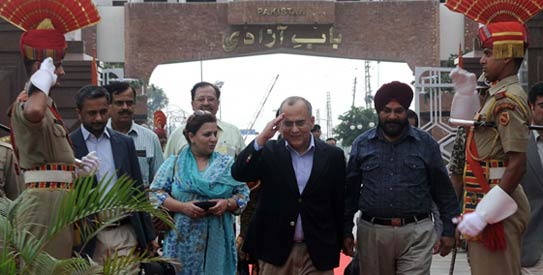
ISLAMABAD: The meeting between foreign ministers of India and Pakistan on Wednesday is expected to be a mere countersigning ritual for the modest progress achieved at the preceding series of meetings of the officials, but with little value-addition by political heads of diplomatic services of the two countries.
Newly-appointed Foreign Minister Hina Rabbani Khar, whose elevation was speeded up before this interaction, will travel to New Delhi on Tuesday. By the time she lands in the Indian capital, Foreign Secretary Salman Bashir, along with his Indian counterpart, Nirupama Rao, would have done most of the preparatory work for the ministerial engagement, reconciling whatever headway could be achieved so far. The process, which started in March, has seen a number of official-level meetings alternating between Delhi and Islamabad.
“It is good to be here, back in Delhi, for me personally and for my team. We are here a day ahead to prepare for the foreign ministers’ meeting. The foreign secretary of India was in Islamabad and we have covered some ground and we hope to give the preparations a final touch in the meeting tomorrow,” Mr Bashir was quoted by Indian media as having said soon after his arrival in Delhi on Monday.
The deliverables Ms Khar and her Indian counterpart, S.M. Krishna, are expected to announce include a number of Kashmir-related confidence-building measures for expanding trade and travel across the Line of Control. Both sides are likely to make public their agreement on increasing the number of cross-LoC trading days from two to four and the Muzzafarbad-Srinagar bus service.
Discussions have also been taking place on increasing the number of trading points. At present trading is done through Muzaffarabad-Uri and Poonch-Rawalakot routes, while India has proposed three additional points -- Nauseri-Tithwal, Hajipur-Uri and Tattapani-Mendhar routes.
The two foreign ministers will reiterate their commitment to cooperating on counter-terrorism and may speak about expanding the scope of bilateral dialogue to bring in newer areas of cooperation. The two sides have been discussing visa liberalisation but are unable to sign an agreement.
Beyond this there is little hope that the two foreign ministers will be able to resolve the impasse on more difficult issues like Siachen, Kashmir and even Sir Creek. The last named was once considered to be the most doable until the Indian army hardened its stance on the (Siachen) issue and prevented any forward movement during last month’s meeting.
Politicians are typically expected to attempt to resolve deadlocks that bureaucrats fail to undo, but this isn’t likely to be the case for Wednesday’s meeting. The obvious explanation is that both sides have traditionally been unyielding on issues of strategic importance to them, but there are a few new realities now.
Delhi has been buoyed up changes in American policy nuances towards the region, which envisage promoting India as the regional leader, while the Pakistani foreign minister, new in the job, will have little to negotiate because of her limited skills, understanding of intricate foreign policy issues and, more importantly, the narrow space available to her. Therefore, quite understandably neither side looks to be keen on raising expectations ahead of the meeting.
One obvious signal from the Pakistani camp before the talks was that they intended to push strongly for discussions on Kashmir.
Meanwhile, Ms Khar met a delegation of JKLF, led by Yasin Malik, in Lahore. She said genuine Kashmiri leaders should be part of the dialogue process on Kashmir and that she would raise concerns expressed by the Kashmiri leadership during her meeting with Mr Krishna.
Ms Khar is also likely to meet a number of Kashmiri leaders in Delhi.