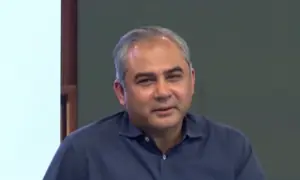
As I walked into the bustling coffee shop, I had to double take to make sure that the man facing me was TV director Syed Atif Hussain. Riding high on the success of Mere Sanwarya Ka Naam and the tear-jerker Zindigi Dhoop Tum Ghana Saya, he is the man of the moment, “It’s good to hear good reviews about my work but trust me I have reached this place after a lot of hard work. I started out as a theatre actor, one with those ‘puppy dog eyes’ and initially all roles offered to me were of the romantic lead. I was part of the serious theatre movement and eventually over a period of time I got roles that allowed me to explore my acting skills and mature as a person. Though I craved being a leading TV actor, somehow my foray into production was a hit-and-miss affair.”
Talking about his first brush with production, he said, “In 1998, everyone was hopping on to the production bandwagon. I wanted to produce too and I got a director to work for me. However, I wasn’t too pleased with the end result and certain that I could do a better job.”
Getting hold of cameraman Mirza Mehmood and writer Fasih Bari Khan, Hussain went on to produce the long play, Jab Koi Dosra Nahi Ho Ga (1999). “After it went on air, Ghazanfar Ali gave me a TV series. I left my job and started making plays.” However, it wasn’t a smooth ride and for him becoming a full-time director was “overwhelming.”
His next ace came when there was a strike in Karachi and the cable networks were down. “The long play Mere Sanwarya Ke Naam with Sonia Khan, Humayun Saeed, Hassam Qazi was followed by Ab Yeh Mumkin Nahin with Noman Ijaz, Shagufta Ijaz and Rubina Ashraf. I was lucky that the cast was always good and the characters struck a chord with the masses.”
While his issue-based plays were doing well, Atif’s father, like many others, wasn’t too pleased with the streak of sadness and loss mostly defining his plays, “He told me that I should try making lighter plays ‘there is so much tension in life and you force a viewer to watch more sadness’ he complained. And that’s how Khala Kulsoom Ka Kunba came to be.”
The play, depicting the life of a lower-middle class Urdu-speaking family was a massive hit. From the squabbling of the women of the household to issues of poverty and dark complexion, the play is still remembered for its loud-mouthed but soft-hearted characters.
“It’s reality that people want to watch. I have never been a fan of drawing room plays where the heroine is picture perfect and the hero is devastatingly handsome. I have been a part of the environment that I show in my plays. My characters are based on real people. I have observed them over and over again. This is one reason why my plays are a hit with the masses,” he says.
On the subject of realism in plays, he adds, “Pakistani drama is doing pretty well. While there are the escapist Indian soaps, we have an intelligent audience across all strata of the society that wants quality. We have the viewers switching back to our channels.
“There was a time a couple of years ago when the channel heads wanted the directors to produce soaps and serials with laal peeli deewar aur chamakdar saris but they all flopped. It was a frustrating time for me as a director. I wanted a way out and I made Yeh Zindagi Hai. The play had zero glamour and in it and viewers loved the characters of Bhola and Hajra in it. You have to take an initiative to bring about change in mindsets and I consider myself lucky that my producers placed their unwavering faith in me. Although I left the show after 32 episodes, it’s good to see that it is one of the most watched plays on TV.”
Syed Atif Hussain is also credited for giving new talent to television. Sanam Baloch, now a much sought after actress, made her debut via his tele film Kalak, while Fahad Mustafa got massive recognition as an actor with his serial Veena.
“A lot of people showed faith in me as a newcomer despite my lack of experience. I use this same approach when I work with new people. Everyone needs a chance and with every serial I make, I grow as a person thanks to the lessons learnt.”
Atif says that he desperately wants to make a film, “It’s work, work and more work for me these days. But I do want to make a film and soon. Celluloid is the ultimate experience after all.”