0
0

 KARACHI, Oct 27: Carpets of weed and plastic bags greet you alternately whichever of the narrow lanes you try to enter. Where both are missing, mosquitoes and flies have spread out their own brands of blankets on the pools and puddles of filthy water. This is Altaf Town, or Altaf Nagar as is mentioned in the election commission documents.
Of the myriad problems the locality suffers from, the most prominent and steadily growing one is the overflows of sewerage. All others are its byproducts. A couple of years ago it were vehicles — fire tenders, ambulances, motorcycles — that could not enter the lanes. Now people on foot also have to grope for their way up to their doorsteps. In fact, this is the most wretched, rather the sleaziest, of all legal settlements in the city.
The latest situation is caused by the removal of two pumps installed to drain away the sewage. The contractor removed the pumps following a dispute with the KDA over payment of dues for the service. When the KDA sought fresh tenders for the pumps, the contractor challenged the decision and got stay orders from a court of law, pushing down the residents into deeper troubles.
Representatives of the residents have tried all means at their disposal and approached various authorities to get rid of the scourge.
“The Korangi Town Nazim, Mohammad Jamil Khan, had promised to help solve the problem but has so far done nothing,” said Ghufran, a social worker, striving for the solution of the locality’s problems.
“Earlier we had approached the KWSB chief, the KDA chief and other civic authorities.”
Some people have already left the colony and settled elsewhere, selling their houses for peanuts or renting them out. The others, having no better choice, continue to put up here. And with the fresh elected people in place, their hopes have revived. They believe what the bureaucracy and their local representatives could not achieve over the years, the elected members will do overnight.
Their national-level representative is Nawab Mirza, and Syed Talib Imam represents them in the Sindh assembly. Both legislators belong to the MQM, which developed the shanty town more than a decade ago to settle the people uprooted from the interior of Sindh, and named it after their leader. More than 800 plots of 80 square yards each were created in 1991 on the KDA-owned land adjacent to Bhitai Colony, which is administered by the Korangi Creek Cantonment Board. Many more plots were added to the settlement later.
Makeshift arrangements were made to supply electricity to Altaf Town. Water supply was also arranged quickly and abundantly. However, the sewerage was long in coming. And when it was laid, it was connected to a far-off line of Allahwala Town for disposal. Naturally enough, the dirty water did not move on gravitation as was expected. A couple of pumps were later installed to keep the sewage moving out.
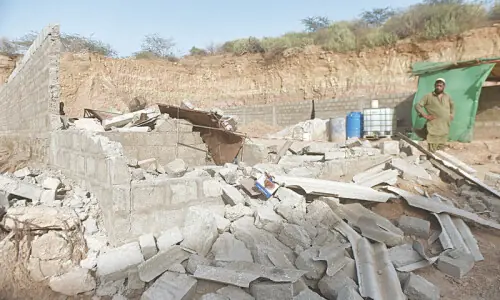
A stranger to the settlement would inevitably wonder how people survive in these filthy conditions. Stench from overflowing gutters, filling up the open spaces, narrow streets filled with haphazardly dumped rubble and earth to make a dry strip winding in front of some houses. Flies and mosquitoes not only turn the day and night of the residents into a hell on turns but also spawn various diseases.
“Doctors are having good business here,” said Riaz Ahmed, a resident. “People, particularly children, suffer from stomach ailments as sewage seeps into the rusting pipes.” As there is no government dispensary, private clinics thrive.
Not a single metre of a road is metalled or even paved. There are no street lights. The KESC people cannot install electric poles at many places where they want because of streets being impassable. Nor can they rectify faults soon.
When the last local bodies elections were being held, its would-be representatives were entangled in a legal battle. Although they won, it was too late for them to contest the elections. The dispute was whether the settlement was under the Korangi Creek Cantonment or the Karachi Development Authority.
The locality has now got representatives both in the national and provincial assemblies. They have found their voice to be raised in the lofty houses of the legislature to echo their problems.
“If it were not named after Altaf Bhai, it would have been in a better shape,” says an activist of the Muttahida Qaumi Movement. “Certain quarters seem to be allergic to Bhai’s name.”
Khalid Omar Chhurra, president of an NGO in Bhitai Colony, the adjoining and marginally better settlement, says the residents are also to be blamed. “Why don’t they come out on the roads and agitate against this flagrant injustice to them?”