



 0
0

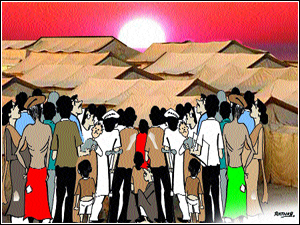 According to press reports (September 25), the government felt rather uncomfortable about a report by the Federal Bureau of Statistics, that said that poverty in Pakistan had increased during 2000-01 and 2001-02. Recent reports by NGOs and donor agencies have voiced similar concern.
The government fears that the rise in poverty will be interpreted by many as being a direct result of official policies, and this interpretation is not very far off the mark. Their policies are mostly the donors’ prescriptions, which, rather than arrest the decline in economic activity, have mostly had the reverse effect, and contributed to a sharp increase in unemployment—the mother of poverty. Income levels, specially of small business and industry, have substantially decreased, income disparity between the higher and lower income groups has been widening and, despite the much trumpeted flow of aid and re-scheduling of loans after September 11 events, this position remains unchanged. The policy of privatization and ceaseless reiteration of the mantra of free market and hopes of bringing in ‘foreign investment’ have not helped. Rather, these have benefited a certain class only.
Income survey, next the GST, and then, slowly but steadily, through increases in taxation, specially indirect, and reduction in the subsidies for social sectors like health and education, the common man’s purchasing power has been eroded. Oblivious to the impact of all these on the middle and working classes, the planners seem to be living in a world of their own, having sweet dreams of ‘foreign direct investment inflows’ though few foreigners are prepared to come and invest in Pakistan despite our all out support to the ‘war against terrorism.’ As against America’s apparent support for our government of the day, what we have is a generally hostile western media and hostile action against the Pakistanis in America.
In contrast to this ground reality, the finance minister has claimed that ‘foreigners are eying the privatization plans in energy and financial sectors, and that a profitable, stable and moderate Pakistan was ‘vital for the world.’ Certainly, it is vital in the sense that no creditor would want his debtor to default and go in the reds. However, this should not be the approach of our custodians who should in fact be more concerned for a stable and prosperous Pakistan for the reason that it is vital for Pakistanis, not because it is ‘vital for the world.
Continuing, he had exulted on his claim that “Pakistan’s recent performance has won kudos from the IMF,” while conceding that “our challenge now is to transfer macroeconomics growth to the benefit of the common man, but we have to stay on the course of reform, because if we do not, things can derail very quickly.” (Dawn, September 30, 02) In other words, there are too many ifs and buts in the policy makers’ minds when it comes to translating the so-called macroeconomics growth to the common man’s benefits.
Poverty alleviation by its very nature requires government intervention, whether by provision of social security or backing for public education and public health or redistribution of income in society through progressive taxation. What we see instead is increasing indirect and regressive taxation, downsizing and restructuring of government organizations, reduced public spending and establishment of ‘elite institutions’ of learning while ignoring the financial needs of public sector institutions and research institutions.
Secondly, the policy of unbridled privatization and retrenchment of workers in the name of ‘restructuring,’ while making organizations top heavy, in terms of salary structure, if not in numbers, militates against the requirements of poverty reduction.
Most governments in Pakistan have treated poverty reduction not as an accompaniment of economic development, but as a kind of charitable ‘obligation.’ But charity is no solution to poverty, except for providing emergency relief in terminal cases of poverty. Compulsory Zakat deduction instituted by Zia’s government has failed to make a dent in poverty, as shown by the constant rise in poverty in recent years.
Now the World Bank has reported a correlation between military expenditure and poverty increase in Pakistan in its report “Poverty in Pakistan, vulnerabilities, social gaps and rural dynamic.” High levels of military spending absorb a significant part of public resources, says the report. In addition, we know that the overall impact of commercial hyper-activity by the military institutions in various field, ranging from education to construction — the various foundations run by the armed forces and the construction and transport establishments run by them in the civilian sectors - makes for a disproportionately higher share of the armed force in the nation’s economy.
In Pakistan, poverty eradication on a long term basis requires not merely administrative measures but social reform, since the key to sustainable poverty reduction is human development through education and public health, though right measures can have an immediate impact in retarding poverty and ameliorating the lot of the poor.
Stability requires that frequent fluctuation in the prices of inputs like petroleum and power be avoided. But rather than absorbing small fluctuation in crude oil price in the international market, the policy of periodic ‘price review’ transfers to the consumers even tiny price increases. Likewise, instead of labour intensive schemes, the government is often involved in needless mechanization in the name of modernization.
The poor generally lose under authoritarian rule [unless it is benevolent] because they have no role in decision making and suffer the ravages of official corruption. Under authoritarian rule, government intervention is often used on behalf of the elite sections of society, and no effort is made to involve the people in decision making so they can make their needs known.
But domestic policies are only one aspect of the issue. Unequal exchange between the rich and poor nations is another dimension of poverty in developing countries that we will not discuss here being beyond the scope of the present article. But its impact is accentuated in those countries like Pakistan whose elite is totally sold to the elite of the ‘developed countries. However, global recession is taking its toll. The effects of ‘globalization’ further add to the difficulties because globalization tends, in general, to increase global inequality both within and between nations, the impact being greater on those closer to ‘globalization’ in the name of free trade. Using objective criteria:Harvard economist Dani Rodrik and others have shown that economic growth peaked in the 60s and 70s when there was less open trade. The growth rates of China and India were higher then. WHO and UNDP statistics also show that inequality is increasing worldwide, that the net worth of the world’s 200 richest individuals is greater than the world’s poorest 2.5 billion people. Moreover, 82 of the 83 million people added each year to the world’s population are in poor countries.
Even where globalization policies have reduced poverty, they have not necessarily reduced the [increasingly visible] inequality. Now one is astonished to note that the government is talking about a ‘free trade pact’ with the US. How ‘free trade’ between the United States and Pakistan, countries wide apart in level of development, could benefit the latter, is beyond comprehension.
Poverty is a relative term, except in case of the ‘absolute’ poor who lack the very basic necessities of life. ‘Objective’ measures of poverty have been defined, nevertheless. US Social Security Administration (SSA) uses a measures they call ‘poverty threshold,’ that measures the cost of a minimum adequate diet multiplied by three to allow for other expenses. This measure obviously changes every year. The US Census Bureau compares pretax cash income with the poverty threshold to determine poverty levels. Alternatively, the Census Bureau uses various adjustments to the official poverty rate that reduces the percentage of people under poverty. It expands income by including food programme benefits, medical care, social services, education, training and housing. Obviously, the intervention of the government is helpful in reducing poverty. But even after taking everything into account, poverty in the leading capitalist nation has increased substantially over the years, and almost 13.7 percent people in the U.S. were declared living in poverty in 1996.
Another measure links poverty with the ‘daily calorie intake.’ Based on daily caloric intake, the Economic Survey 1998-99 put ‘absolute poverty,’ at 17.3 per cent in 1987-8 in Pakistan, down from 46.5 per cent in 1969-70. In 1992-93, it increased to 22.3per cent, rural areas being afflicted with greeter poverty. The UNDP’s 1998 Human Development Report puts it at 34.0 per cent.
The perception of poverty in the people’s minds is often more important and far reaching in its effects than poverty itself. That inequality accentuates the sense of deprivation is clear from the fact that many people measure poverty subjectively by simply comparing themselves with their neighbours and acquaintances.
Besides low per capita income and income inequality, other poverty indicators such as high infant mortality, low life expectancy, low literacy rates, high incidence of disease, and so on, that are more widely prevalent in some regions than in others, point to regional disparities. NGOs’ reports on poverty often highlight these disparities. The report by Federal Bureau of Statistics is said to have been withdrawn on ‘technical grounds,’ citing wrong methodologies used in preparing the report, but regional / ethnic inequalities have greater potential to augment the people’s sense of deprivation and cause a political fallout.
While the World Bank report indicates military expenditure, it does not mention the structural adjustment programmes and macroeconomics stabilization measures that usually impose heavy burden on the poor, besides reducing economic activity. The source of these problems is the debt crisis engendered by the heavy debt burden of poor nations, itself a legacy of imperialism.
The neo-imperialism being pursued by the rich nations further complicates and exacerbates this situation. The World Bank and the IMF’s policies that impose on the indebted, poor countries, conditionalities in ‘Structural Adjustment Programmes’ in return for the so-called financial bail-out packages, seem only to have deepened poverty all over the third world. The worst victim of these policies has been Latin America, Argentina’s plight being a glaring example. In Tanzania, they made education and health more costly, with the result that the GDP dropped from $ 309 to $ 210 per capita in about 15 years and the literacy rate fell and poverty increased to encompass 51 per cent of the population. Faced with criticism, these agencies changed the label of their prescriptions from SAP to PRGF. [Dawn, 30 September 2002] When the World Bank officials praise any third world nation like Pakistan’s ‘poverty reduction’ programme, it is usually a euphemism for how much its government adheres to restructuring programmes [SAP].






























