0
0

SANAA: President Ali Abdullah Saleh was burned over 40 per cent of his body and suffered bleeding in the brain from last weekend’s attack on his palace, US officials said Tuesday, indicating his wounds were worse than initially reported. The revelation casts doubts on a quick return to Yemen and spells a deepening power vacuum.
In the wake of Saleh’s evacuation to Saudi Arabia for treatment, Yemen’s violence escalated, with government troops battling Islamic militants and opposition tribesmen in two southern cities on Tuesday. The military said it killed 30 militants who were among a group that took over the city of Zinjibar last week amid the country’s turmoil.
The United States fears that al Qaeda’s branch in Yemen - one of the terror network’s most active, blamed for two attempted anti-US attacks - will take advantage of the chaos to strengthen its base in the country.
Washington and Saudi Arabia are pushing Yemeni officials to seize the opportunity of Saleh’s evacuation to immediately begin a transfer of power and formation of a new government. The US ambassador in Sanaa spoke with Vice President Abed Rabbo Mansour Hadi, who is acting president, to press the American view, State Department spokesman Mark Toner told reporters in Washington.
Toner said he wasn’t sure how long Saleh would undergo treatment in Saudi Arabia, or whether he still planned on returning. But he said Yemen needed to move forward in the meantime.
“We need to see all sides moving forward on a constructive basis,” he said.
Friday’s attack on Saleh’s palace compound came amid two weeks of battles in Sanaa between government forces and opposition tribesmen determined to drive him from power. The fighting pushed the impoverished country closer to civil war after four months of street protests by hundreds of thousands of Yemenis failed to oust Saleh, who has been in power for nearly 33 years.
On Monday, Hadi said Saleh, in his late 60s, was improving after a series of operations in Saudi Arabia and would return home “within days.” If Saleh were to return, it would almost certainly re-ignite the fighting in the capital, which is only barely being contained by a Saudi-brokered cease-fire.
But the revelations by US officials suggested Saleh was in no condition to return soon. Three officials said Saleh, in his late 60s, had burns over 40 per cent of his body and bleeding in his skull. They spoke on condition of anonymity because of the sensitivity of the situation. Yemeni officials have said Saleh suffered heavy burns on his face, neck and chest. One of the operations in Saudi Arabia was to remove wood fragments embedded in his chest.
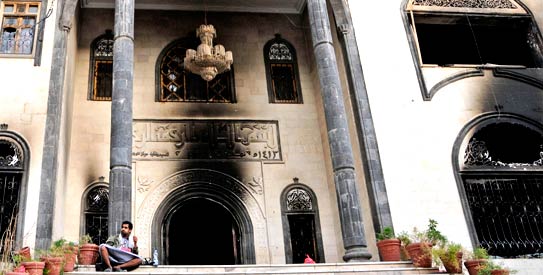
Yemeni officials have said a rocket hit a mosque in the presidential palace compound where Saleh and his senior leadership and several hundred others were praying. At least 11 guards were killed and more than 150 people wounded.
The strike was a devastating blow to Saleh’s top circle of power.
The prime minister, his two deputies, the heads of the two houses of parliament and the head of the ruling party bloc in parliament were all evacuated to Saudi Arabia with severe injuries. One deputy prime minister, Rashad al-Alimi - who is Saleh’s most important security adviser - was still unconscious when evacuated and his condition in Saudi Arabia is not known. The other deputy, Sadeq Abu Ras, lost a leg. The governor of Sanaa, Numan Duweid, suffered a severed leg and hand and was in a coma, Yemeni officials said.
The cause of the blast, however, remained unclear. Three US officials and one former US official said intelligence reports suggest the explosion was from a bomb planted in the mosque. The officials spoke on condition of anonymity to discuss the intelligence. Yemen’s Deputy Information Minister Abdu al-Janadi said the attack was still under investigation.
Footage from the mosque after the attack, aired on state TV, seemed to have indications of a rocket attack, however, with a hole punched through the front wall - near where Saleh and his officials would have been standing at the head of the congregation - and no visible bomb crater amid the scattered wreckage of the room.
The uncertainty amid Saleh’s absence with no sign of an imminent power transfer raises fears of escalating chaos.