28
28

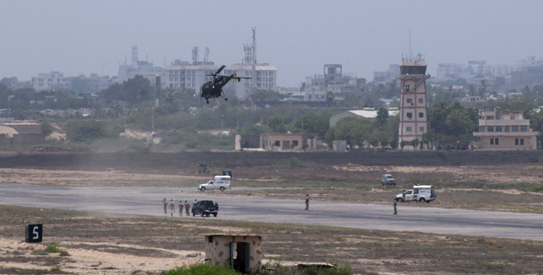
Let me begin this article by saying that I am a journalist and not a security expert. However, the events of May 22, 2011, when PNS Mehran Base came under attack, have had me thinking, again not as a security expert but as a Pakistani trying to make sense of it all.
The Mehran Base ordeal came to an end after 16 hours, with fifteen men, including eleven from the armed forces, losing their loves. While the attack highlights the threats Pakistan faces from what one can call ‘rogue elements’, its also sheds light on how inadequate security in a sensitive zone led to a debacle that could have been avoided.
There were conflicting views of defence experts commenting on TV regarding this. Some are of the view, including the Navy spokesperson, that this was not a security lapse. Which raises the question: what was it then? They say that the terrorists had entered through areas where the security had been the weakest.
If this isn’t a security lapse than what is? The fact that under the circumstances any potential entry point is left weak just gives the terrorists more room to act. Some of the experts also think that such an operation may not be a security lapse but rather an inside job.
To top it off, the Naval spokesperson was quoted on TV channels that the terrorists took advantage of the darkness. Does that mean that if the enemy attacks in the night, we will be helpless? Not a very secure thought. On the other hand, the other half of the experts claim that it was a severe security lapse revealing that the enemy is either too powerful to contain, and could target sensitive targets at its pleasure. They claim that by attacking institutions like the armed forces and their assets, the terrorists are sending out a wider message of their power amidst the population.
Looking at the location of the base reveals that it is surrounded by various landmarks which could allow the terrorists to get into the base with ease. On one side is the long meandering main road, Shahrae Faisal, which links two major parts of the city. This road cannot be manned throughout and therefore may have provided the much needed entry points to the terrorists.
One side of the base is flanked by the residential area, Shah Faisal Colony, which is sometimes considered to be a hotbed of several political and ethnic parties. Miscreants could easily move in here and have visual points to locate their targets and follow the guards’ duty change, timing their entry time.
The third side of the base has a railway track which is only separated by the Malir River. This river can act like a moat for the base when full and an easy camouflaged passageway for terrorists when it is partially dry. This moat leads to the base’s rear wall, which is protected by a crown of barbed wire. However this was not an obstacle for the terrorists, as it just took them ordinary ladders to scale and shears to snip the barbed wire crowing the wall.
The apparent ease with which the terrorists brought in their ammo over the wall reveals that this area was a blind spot for the base’s security administration. Their equipment may have been brought in days before and stashed on the bases’ bushes near the ‘vacant long run way’, and only taken out when needed. Or maybe they kept their equipment outside close to the moat and later hauled it in via the railway track in the night.
Media reports reveal that eyewitnesses claim to have seen uniformed men scaling that wall before the siege but they had thought nothing of it since these men were wearing different uniforms. Even if someone had considered this strange, no one would have reported it because most people wouldn’t have wanted to ‘interfere’ in official business or didn’t want to get into any kind of trouble.
This is why terrorists and other criminals find safe havens amidst us. This is mainly because of the big gap between the civilians and security forces in Pakistan, the two keep away from the other as if they were infested. This piece of the jigsaw only came to light in the aftermath of the terrorists attack.
Media also revealed that a squatters’ village was scattered behind the base, which could have served as a great refugee for miscreants. These men may have spent many days planning their attack among these marginalised settings.
Repeated terrorists attacks on sensitive targets and soft targets reveal that terrorists were not only well equipped but well planned. They have recruits who are ready to die for the cause and are not wary of facing well trained armed forces personnel on the latter’s turf.
Apparently the security measures when the Mehran Base attack happened were not good enough. Had there been stronger counter terror measures implemented beforehand, the attack would have never happened and precious lives could have been saved.
Annie Sibtain Rizvi is a freelance journalist and tends to ponder over the socio-political happenings with an empathetic outlook.