0
0

NEW DELHI: India sounded the alarm on Friday that Pakistan had become a “fragile” state with militant groups nurtured as “an instrument of state policy” uniting in their battle against the government.
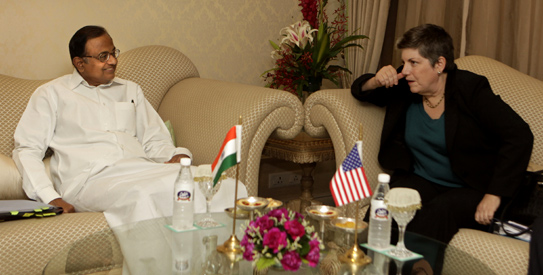
Home Minister P. Chidambaram issued the warning at the start of talks with US Homeland Security Secretary Janet Napolitano, who is on a four-day trip to India to strengthen anti-terror information-sharing between the countries.
New Delhi has long accused Pakistan of harbouring militant groups, but analysts say it is becoming increasingly concerned that growing unrest could compromise the safety of the country's growing nuclear arsenal.
Chidambaram said in a statement that the “global epicentre of terrorism” was in Pakistan where “the vast infrastructure of terrorism in Pakistan has for long flourished as an instrument of state policy”.
He continued: Today, different terrorist groups, operating from the safe havens in Pakistan, are becoming increasingly fused; the society in Pakistan has become increasingly radicalised; its economy has weakened.
“The state structure in Pakistan has become fragile.”
US Secretary of State Hillary Clinton flew into Pakistan on Friday with “tough questions” for the country's leadership nearly a month after US commandos killed Osama bin Laden near Islamabad.
The US diplomat met Pakistani President Asif Ali Zardari and Prime Minister Yousuf Raza Gilani, then headed into talks with army chief Ashfaq Kayani and the chief of Pakistan's intelligence agency Ahmad Shuja Pasha, officials said.
She is also likely to try and smooth over relations between Pakistan and the United States, which sank to new lows after US Navy SEALs swooped on the al Qaeda chief's compound in Abbottabad on May 2.
Nuclear-armed India and Pakistan have fought three wars since independence from Britain in 1947.
A stop-start peace process is officially back on, but ties remain frosty.
India broke off formal peace talks with its neighbour after the 2008 attack on Mumbai that left 166 dead and was blamed on the Pakistan-based Lashkar-i-Taiba militant group.
New Delhi and has repeatedly called on Islamabad to bring the perpetrators to justice. Pakistan has charged seven people but none has been convicted.