0
0

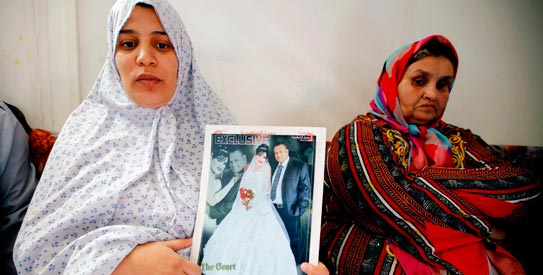
BENGHAZI: The faces stare out of photographs that feature a name, maybe a phone number, or sometimes just a date – they are all that people have to go by in their search for loved ones missing in Libya's revolution.
Portraits of men of all ages fill the walls of Benghazi's Jalaa hospital, where there are more than 100 photographs on display for patients and passers-by to contemplate.
Some are new and some weathered after spending weeks on the wall. Others, albeit very few, have been torn down, a sign that some of the missing have been found, be that dead or alive.
More than three months into the insurrection against Libyan leader Muammar Qadhafi, the hospital walls tell the stories of all those missing since the city took up arms against the army on February 17, and of the rebels who went to the front and did not return.
Sami Naji Absallam, 17, set off from his home on February 20 with his friends on a protest march that was heading to the Katiba barracks in Benghazi that soon became the scene of fierce fighting.
“Sami was inside. We didn't see him again,” recalls Ahmed al-Attar, a family friend.
“In early March, we got a call from someone saying they'd seen him in Ajdabiya, then another saying the same thing. Our neighbours thought they saw him on TV protesting in Tripoli in support of Qadhafi. But, really, I don't know what to think,” the elderly man said.
In a city where rumours spread fast and false information infuses the storyteller's imagination, the families of missing persons are powerless to find their loved ones.
Majdi Blahu has been looking for his friend and colleague, Saad Atach, for more than two months.
The two of them used to work together at a construction site near Benghazi's southern gate, a neighbourhood Qadhafi's tanks bore down on before they were stopped in their tracks by coalition air strikes.
Majdi said he was speaking to his friend mid-morning on March 19 when he heard the phone “drop to the ground.” “I could only hear the sound of the wind in the telephone. When I tried to ring him back, my call was rejected. Then the phone was turned off,” he said.
Majdi never found a body or his friend's car.
In vain, he made contact with the Red Crescent and non-governmental organisations, distributed flyers and did the rounds at every hospital, as well as searching morgues.
“Qadhafi's troops could have killed or arrested him,” he said.
The Libyan Red Crescent, which has offices in Tripoli and Benghazi, has files of more than 1,200 missing people who disappeared either in Benghazi or the key western port city of Misrata which Qadhafi's forces besieged for two months.
“We are handling 676 cases in Benghazi and 697 in Misrata,” said Omar Budabus, who heads the missing persons department of the Red Crescent in Benghazi.
“The majority of them disappeared on the front line,” he added.
He said 41 persons were found alive, 21 dead, and 231 are prisoners of the regime in Tripoli.
The latter, Budabus said, were identified thanks to the testimony of prisoners who managed to escape or who appeared on Libyan television, forced by the regime to demonstrate in support of Qadhafi.
The fate of 383 others remains a mystery for both their relatives and the Red Cross.
“We are still negotiating access to the prisons of Tripoli,” said Dibeh Fakhr, spokesman of the International Committee of the Red Cross.
“The lack of communication and freedom of movement between the east and the west, coupled with the fact that families have been displaced or left the country, makes it hard for families to get news” of the missing, he added.
Dozens of cadavers and remains have been buried without identification, according to a medical examiner at Jalaa hospital.
Among these were the bodies of nine people found in the Katiba barracks on February 20, of soldiers presumed to be loyal to Qadhafi, as well as bodies of those who were struck by French warplanes on March 20 and other corpses found on the front line.
“Our morgue received the bodies of 350 rebels as well as 80 bodies that could not be identified,” said Khaled al-Mugaspi.
Despite a stalemate on the Ajdabiya and Brega axis, Libyans continue to disappear, among them Ayub Abdel Karim, a 21-year-old rebel who vanished on May 10.
His brother, Qais, said the young man and his cousin were returning from Ajdabiya to Benghazi when Ayub received a call on his mobile phone.
“Someone was waiting for him on the southern checkpoint of Benghazi. He went back the opposite direction with this man, a Kalashnikov and money,” said Qais.
“I searched the whole road, up to kilometre 40 marking the front line, without finding any trace of my brother,” he said.