0
0

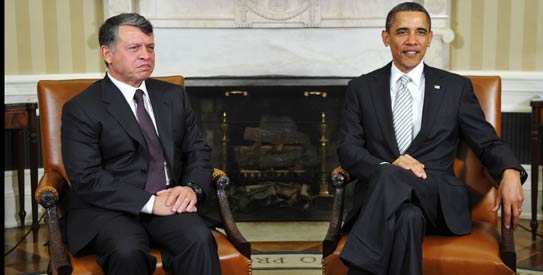
WASHINGTON: US President Barack Obama warned Tuesday that political turmoil battering the Middle East made it “more vital than ever”that Israel and the Palestinians get back to the negotiating table.
Despite a mood of deep pessimism surrounding Obama's peace drive in Israel and the Palestinian territories, the president, during a meeting with Jordan's King Abdullah II, said frozen talks must be revived.
Obama said he and the king agreed “despite the many changes, or maybe because of the many changes that have been taking place in the region, it's more vital than ever that both Israelis and Palestinians find a way to get back to the table.”
Talks, which have been frozen since late last year because of a row over settlements, should “begin negotiating a process whereby they can create two states living side by side in peace and security,” Obama said.
The Oval Office meeting with the king came at the start of a week of intense US Middle East diplomacy, which includes a visit to Washington by Israeli Prime Minister Benjamin Netanyahu and Obama's big speech on the “Arab Spring” on Thursday.
Almost as soon as taking office in January 2009, Obama made clear that forging Middle East peace and a Palestinian state would be a high diplomatic priority on his watch, and one on which he would wager political capital.
But more than two years later, the situation seems more dire than when he took office. Direct talks between the Israelis and Palestinians, painstakingly brokered by Washington, collapsed last year in a row over settlements.
And the lack of direction and general malaise seemed to be summed up by the resignation of Obama's Middle East envoy George Mitchell last week.
The situation took another dire turn on Sunday as 14 people were killed as Israeli troops shot at thousands of Palestinian demonstrators seeking to cross its borders, and blamed Syria and Lebanon for the incursions.
The clashes erupted as Palestinians marked the anniversary of Israel's founding in 1948.
Obama's political opponents have accused him of inconsistency on the varied revolutions in the Arab world and warn he has been too slow to leap to the defense of demonstrators facing brutal crackdowns in nations like Syria.
As revolts have battered Tunisia, Libya, Egypt, Syria, Yemen and Bahrain in turn, White House aides have warned that each nation is distinct and say a one-size fits all doctrinal policy would be inappropriate.
The president's week of diplomacy will be carefully watched for clues on the next moves in his stalled Middle East peace drive.
Obama has had a rocky relationship with Netanyahu and seen his credibility with the Palestinians recede, and now few observers of the Middle East see any chance for progress.
US officials seem privately despondent, both at Netanyahu's unwillingness to make concessions to the Palestinians, and at a Palestinian unity deal between Fatah and Hamas that has hardened the Israeli line even more.
The Israeli leader, managing a volatile conservative coalition, on Monday branded the Palestinian leadership a “catastrophe.”
Israelis view Hamas, which rules the Gaza Strip, as a terrorist group and say its presence has tainted the Palestinian cause.
Netanyahu is due in Washington for White House talks with Obama on Friday, and will address both chambers of the US Congress next week.
Both leaders will be seeking a way out of a looming crisis as the Palestinians threaten a unilateral declaration of statehood at the United Nations General Assembly in September.
Obama is in a tricky spot, since, hoping to jog Israeli-Palestinian peace talks into life, he last year set September as a deadline for a framework agreement on a Palestinian state.
Now he risks being seen in the Arab world as the man who blocks the road to Palestinian statehood.
Palestinian leader Mahmud Abbas said Tuesday that the bid for international recognition was not a “stunt” and would contribute to achieving peace with Israel.
“Our quest for recognition as a state should not be seen as a stunt; too many of our men and women have been lost for us to engage in such political theater,” Abbas wrote in an opinion piece for the New York Times.