



 1
1

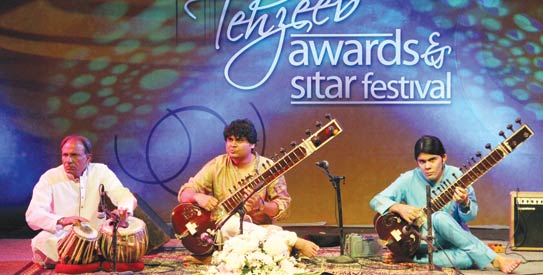
As crowds arrived last week to listen to the maestros of the lute instrument at the Tehzeeb Foundation’s two-day Sitar Festival held in Karachi, it drove home the point that an unwavering niche audience will always remain loyal to classical music performances and events happening anywhere in the city. Fortunately, from behind the scenes, some serious-minded people are making sure that classical music is offered to an avid audience on a regular basis. The names of founder members of the Tehzeeb Foundation, Malahat and Sharif Awan make it to this list.
The Sitar Festival was a well-conceived event as the choicest sitar players offered a divine collection of exquisite classical music: Ustad Rais Khan of the Mewati gharana and recipient of the Pride of Performance award enriched the beautiful raag peelu as his adroit fingers trilled up and down the sitar to create a mesmerising effect. Another heavenly treat this year was the rendition in raag darbari by Ashraf Sharif Khan, recipient of the Khwaja Khurshid Anwar and the Amir Khusro awards. He had flown in from Germany to perform at the event.
The effort was every bit worth the applause it garnered on the two nights, especially for sitar players Ustad Rais Khan and his progeny Farhan Khan, as well as Suhel Rais Khan and Huzoor Hasnain Khan, Ashraf Sharif Khan, Sajid Hussain, Rakae Jamil and Beena Raza, to name just a few. Furthermore, a brief awards ceremony paid tribute to the stalwarts in the fields of literature, painting and music. Acclaimed Urdu humour writer Mushtaq Ahmad Yusufi presided over the event and gave away awards to Zehrah Nigah, Asad Mohammad Khan, Salima Hashmi, and vocalists Babar Niazi and Javed Niazi.
“Ustad Nafees Ahmed was grossly missed at the festival,” noticed Rumana Hussain of NuktaArt and author of the book, Karachiwala. She is a regular at most classical music performances. “The commendable thing about Tehzeeb Foundation’s event was the fact that they had celebrated one instrument in the festival which was quite appealing.”
Rumana has taken sitar-playing for nine years and claims to know the art well. “I felt that including Beena Raza, the only female performer, was encouraging but she needs to master her art more to capture the effect.” She was also happy that the sponsor list was not imposed on the audience on some front near the stage.
Rumana had a reservation though, “The cash given away to the award recipients should be used instead for the upkeep of deserving artistes who make a living out of the meager remuneration paid to them in pursuing this art form. They put their heart and soul into classical music and dedicate their entire lives to it,” she said.
It must be mentioned here that the Tehzeeb Foundation award recipients are acknowledged for keeping the candle burning. Ayla Raza, one of the founder members of All Pakistan Music Conference (APMC), endorsed the idea of the award ceremony wholeheartedly. “The fact that there are more of such organisations today that are promoting classical art and organising performances is very encouraging in a society that has forgotten to appreciate its own art and culture. In promoting the arts, we are also trying to shape and see the society in such a way that we appreciate our culture,” she said.
Needless to say that classical music performances don’t have a mass appeal, but it is tricky to say whether these performances should be ticketed, strictly controlled by invite, or simply be walk-in events.
While finances are a big issue in organising events to promote the cause, many believe that there may be more funding than meets the eye. “There is funding available for classical music performances but there is a lot of struggle involved in trying to get it,” says Ayla. “However, I personally feel that we should not be looking for an appreciative audience exclusively. These performances should be open to public to nuance the audience into the arts and people should be given an option whether or not they want to attend an event of classical music.”
Sharif Awan announced on the second night of the festival that the foundation did not see much point in opening membership at this point in time because “we feel that you own the Tehzeeb Foundation and it owns you.”
But does that lofty feeling finance a pricey an event as the Sitar Festival?
“My worry is that all these organisations are offering classical music performances for free. This should not happen,” says Humayun Ansari who actively promotes classical music. He is an assistant professor at the IBA and patron of its music society. “People should pay a token fee to attend these events,” he adds.
The Tehzeeb Foundation has taken up the uphill task of preserving classical music and puts up the work for sale for an avid audience at their events. “Last year we sold six copies of recorded classical music; this year we sold 12 such copies,” said Sharif Awan during the event. “Such minimal inclination towards the promotion of classical music is not encouraging, but we are not dissuaded by it. We are able to sell the copies in the international market also because the recording is of international quality.”
Which brings us to an important question: what does the classical music artiste ultimately gain from the emerging platforms that promote classical art and music? While Sampurna (which has reportedly reduced operations), the APMC and now the Tehzeeb Foundation are some of the significant platforms that come to mind that contribute immensly to this struggling art, have they been successful in providing a comfort zone to the classical music performers?
“An increase in the number of performances creates a sense of motivation for the artistes as they perform for a gathering of the upper strata, even those taking place at the Arts Council. However, there runs a risk of classical music artistes becoming the underdog which makes them concerned whether they will be used for a performance and then left in the lurch, or sincerely looked after. I believe that artistes should be trained to manage their business in today’s world so that they do not feel slighted in the bargain. Art needs business and business needs art,” says the patron of IBA’s music society.

























