0
0

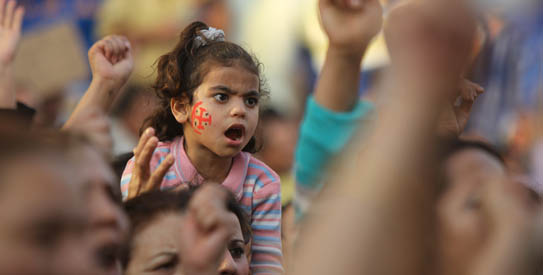
CAIRO: Thousands of people rallied in Cairo's Tahrir Square on Friday calling for unity and the rule of law to be enforced after attacks on churches, state television reported.
Footage aired from the iconic square, the epicentre of protests that overthrew president Hosni Mubarak in February, showed thousands of protesters waving flags and banners in support of national unity. Fifteen people were killed in clashes on Saturday after Muslims surrounded a church in Cairo demanding the handover of a woman they said Christians had detained after she converted to Islam and married a Muslim.
The Muslims also set fire to a second church.
The unrest threatened to drive Egypt's often tense religious tensions to the brink, prompting the military to arrest more than 200 people it said will swiftly be tried.
Activists had called for a mass show of unity on Friday, which has become a traditional day of protest after the weekly Muslim prayers at noon.
The protesters gathered in the square ahead of the prayers also waved Palestinian flags. Activists have called for a march to neighbouring Gaza at the weekend, coinciding with the anniversary of Israel's establishment, to protest the Israeli occupation.
The interior ministry has urged them to cancel the march.
The young Egyptian woman whose complicated love life led to last weekend's clashes was arrested on Thursday and charged with marrying more than one husband, a judicial source said.
Abeer Talaat Fakhry, 26, was living with her Christian husband in the southern city of Assiut when she ran away from home, converted to Islam and informally married Muslim Yassin Thabet.
Copts account for up to 10 percent of the country's 80 million people. They complain of discrimination, and have been the targets of fairly regular sectarian attacks.
The most recent violence has been blamed on a hardline Islamist sect, the Salafists, who have regularly staged protests demanding the church release women they believe converted to Islam.
The sect was mostly apolitical under Mubarak, but since February it has grown more assertive and its leaders say they will form parties to contest a parliamentary election in September.