0
0

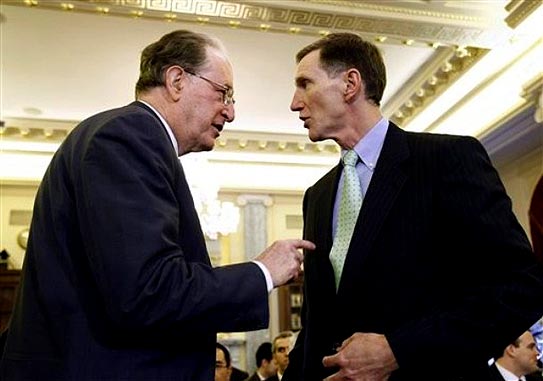
WASHINGTON: Privacy and consumer groups welcomed a “Do Not Track” bill introduced in the US Senate on Monday that would let Internet users block companies from gathering information about their online activities.
The Do-Not-Track Online Act of 2011 was introduced by Democratic Senator Jay Rockefeller of West Virginia, the chairman of the Senate Committee on Commerce, Science, and Transportation.
“Recent reports of privacy invasions have made it imperative that we do more to put consumers in the driver's seat when it comes to their personal information,” Rockefeller said in a statement.
“Consumers have a right to decide whether their information can be collected and used online,” he said. “This bill offers a simple, straightforward way for people to stop companies from tracking their movements online.”
Rockefeller's bill would create a “legal obligation” for online companies to honor the choice of consumers who say they do not want to be tracked online and give the Federal Trade Commission the power to pursue any company that does not honor the request.
Rockefeller's bill comes amid a flurry of privacy legislation in the US Congress and on the local-state level.
US senators John Kerry and John McCain unveiled an online privacy bill last month and two members of the US House of Representatives released a draft last week of a separate “Do Not Track” bill aimed at protecting children online.
“Do Not Track” legislation has also been introduced in the California state senate, drawing criticism from some companies reliant on tracking Web users for targeted advertising.
Rockefeller's bill was welcomed on Monday by the American Civil Liberties Union, Consumer Federation of America, Consumers Union, Electronic Frontier Foundation, Privacy Rights Clearinghouse, Consumer Watchdog, Consumer Action, and the Center for Digital Democracy.
Susan Grant of the Consumer Federation of America said it would “give Americans the right and the right tools to browse the Internet without their every click being tracked for marketing and other purposes.”
“The current model creates an economic incentive for tracking and if consumers don't have the ability to 'opt-out' the result is going to be a detailed portrait of our online activities,” said Chris Calabrese of the American Civil Liberties Union.
Jeffrey Chester of the Center for Digital Democracy said the bill strikes a balance between protecting the personal information of Web users and the needs of businesses to conduct electronic commerce.
“The bill shows that you can protect privacy and also promote e-commerce because it allows websites to engage in the necessary data collection so they can generate robust revenues,” Chester said.
Jamie Court of Consumer Watchdog noted that Mozilla, Microsoft and Apple are incorporating a mechanism into their Web browsers to send a “Do Not Track”message but there is currently no legal requirement that a website honor the request.
Court also welcomed provisions in the Rockefeller bill that would apply “Do Not Track” standards to mobile devices.
Apple and Google are to attend a congressional hearing on privacy on Tuesday following controversy over location-sharing features on the iPhone and Google's Android devices.