



 0
0

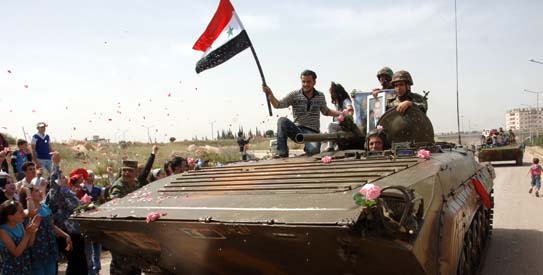
AMMAN: Security forces have moved into central Syria and coastal areas before Friday prayers in a test of will for demonstrators determined to maintain protests against the rule of President Bashar al-Assad.
In a show of force, tanks have taken up positions near the urban centres of Homs, Rastan and Banias in the past two days.
Last week, Assad ordered the army into Deraa, cradle of the uprising that began with demands for greater freedom and an end to corruption and is now pressing for his removal.
An ultra-loyalist division led by his brother Maher shelled and machine gunned Deraa's old quarter on Saturday, residents said. Syrian authorities said on Thursday the army had begun to leave Deraa, but residents described a city still under siege.
Troops were also deployed in the Damascus suburbs of Erbin, Saqba, and Douma and in the town of Tel, north of the capital.
A senior diplomat said demonstrations after Friday prayers, the only chance Syrians have to gather legally, were expected to increase "incrementally, not massively" in numbers compared with a week ago when tens of thousands took to the streets.
Human rights campaigners say security forces killed at least 62 civilians, including 17 in Rastan alone, during those protests.
A doctor who planned to take part in Friday's demonstrations said: "Indiscriminate killings and inhumane arrests have generated total disgust among the average Syrian."
"Soldiers with rifles no longer deter people. The propaganda that this regime is the only guarantor of stability no longer washes," he said.
The United States, which had joined a European drive to improve ties with Assad under the Obama administration, called the attack on Deraa "barbaric".
Derra Relief
Aid workers from the Red Cross and Red Crescent delivered their first emergency relief supplies to Deraa on Thursday, bringing drinking water, food and first aid materials. They had no immediate information on casualties in the city.
Human Rights Watch cited figures from Syrian rights groups saying 350 people had been killed in Deraa. It urged authorities on Friday to "lift the siege" on the city and to halt what it called a nationwide campaign of arbitrary arrests.
"Syria's authorities think that they can beat and kill their way out of the crisis," said HRW's Middle East director Sarah Leah Whitson. "But with every illegal arrest, every killing of a protester, they are precipitating a larger crisis."
Diplomats said the European Union could reach a preliminary agreement on imposing sanctions on Syria's ruling hierarchy on Friday, but had yet to decide whether Assad should be included.
Iran, which the United States accused of helping Assad in his efforts to crush the demonstrators, said Syria's rulers were aware of plots by the United States and Israel to destabilise its only Arab ally.
Human rights campaigners say army, security forces and gunmen loyal to Assad had killed at least 560 civilians during seven weeks of pro-democracy demonstrations. Thousands of people had been arrested and beaten, including the elderly, women and children, they said.
The authorities blame "armed terrorist groups" for the violence, including the killings of civilians and members of the security forces.
Syrian television showed what it said were confessions of terrorists arrested in Deraa and caches of weapons it said were seized.
Assad said the protesters were part of a foreign conspiracy to cause sectarian strife.
His father Hafez al-Assad used similar language when he crushed Islamist and secular challenges to his rule in the 1980s, culminating in the violent suppression of an uprising in the city of Hama in which 30,000 people were killed.
Hafez al-Assad lost two wars to Israel, as defence minister in 1967 and as president in 1973. He maintained Syria's position as a central player in Middle East geopolitics by building ties with Shi'ite Iran and backing Palestinian guerrilla forces.
The younger Assad has reinforced the anti-Israeli alliance with Tehran, despite disquiet on the part of Syria's majority Sunni population.




























