0
0

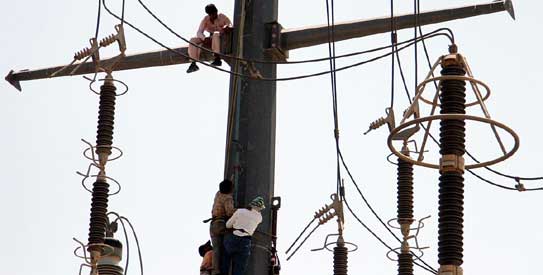
ISLAMABAD: As the government tries to cope with energy shortfalls and an angry populace, it is forced to acknowledge the growing divide and friction between the southern and northern regions of the country over energy resources. The situation threatens to grow more explosive with the recent decisions the government has taken in the power sector.
The divide has been manifesting itself in a number of ways though government officials are generally averse to acknowledging it.
The most obvious has been the gas shortage in Punjab, which has had a devastating impact on its industrial sector. Under the new constitutional arrangement the province that is producing the natural gas has the right to meet its own needs before supplying it to other provinces.
Federal Minister for Water and Power Naveed Qamar said that this safeguard was introduced in the Constitution to protect Balochistan’s rights though “it is ironic that it became effective in 2010” when production had increased in Sindh.
However, for the industrialists in Punjab this is a case of discrimination and Chief Minister Shahbaz Sharif has mentioned this in his speeches though his PML-N has not highlighted it too frequently, probably because it knows that constitutionally its case is weak.
Similar was the case of recent fuel crisis that hit the nation when Attock Refinery Limited (ARL) stopped supplying furnace oil and diesel to Pakistan State Oil. The decision hit Punjab more as the ARL is the major supplier of almost all petroleum products to the northern part of the country. Despite government persuasions, the ARL has declined to resume supplies, though it has agreed to provide products such as petrol and jet fuel on cash payment.
The problem was that the government had enough fuel but ‘not in the right geographical locations’. Officials said they had furnace supplies for 22 days and diesel for 18 days but most of these stocks were in the southern part of the country – ranging from Karachi to Multan. Hence these supplies could not be immediately moved to the northern region. As a result, power generation from Kot Addu Thermal Project has been affected and completely stopped at Saba power, Japan Power and Southern Electric – all in Punjab.
However, this is not to say that Punjab is at the receiving end all the time.
With the government’s recent focus on the power sector, its biggest headache will be the tough decisions it will have to take in Sindh and those parts of Punjab that are the PPP’s strongholds. At the same time, these decisions will favour the PML-N areas.
On Thursday it was reported that the Council of Common Interests had agreed to allow provinces to manage their own electricity tariffs.
The decision will pit the southern part of the country against upper Punjab, Azad Kashmir and Gilgit Baltistan. And the reason for this is that the companies feeding Hyderabad, Karachi, Multan and Peshawar throw up the highest defaults of electricity bills and leakages from the system.
And once the tariffs are rationalised and every region pays not just for the electricity it consumes but also for the leakages it is unable to check, cities such as those mentioned above would pay more than, say, Lahore.This can prove politically explosive, for the president, the prime minister and the energy related ministers all belong to the southern region.
Different tariffs Mr Qamar says the government will impose different tariffs for various distribution companies. “This will reveal how the different companies are performing. In the current uniform tariff mechanism, their (in)efficiencies are camouflaged,” he said, adding that since the president, the prime minister and minister for power hailed from the south it could be politically easy for the government to take such a decision.
The minister said that with the rationalisation of electricity subsidies, the tariffs of all the companies would not go up automatically. For example, there would be no need to increase the tariff for Islamabad Electric Supply Company. On the other hand, the tariff of Hyderabad Electric Supply Company would have to be hiked to pay for its losses which amounted to 30-35 per cent.
Once different tariffs were implemented, subsidies would be withdrawn. Though the government could still provide assistance to loss making companies, the new system would mean that profitable companies would no longer have to pay for the losses of their unprofitable counterparts. Currently, Karachi, Hyderabad, Multan, Peshawar and Quetta electricity companies are big loss makers.