0
0

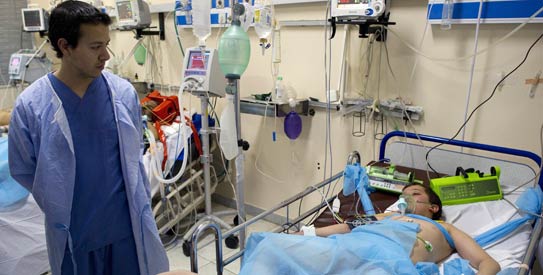
MISRATA: Ten-year-old Mohammed writhes in his hospital bed, and his eyes are open, but he is not conscious. It's unlikely he ever will be conscious again – a sniper's bullet made sure of that.
“It was a high-velocity bullet. It went in the left side of his head and out the other side, taking brain matter with it,” Dr Abdul Kather Muqtar explained in the intensive care unit of the main hospital in rebel-held city of Misrata in western Libya.
He and other medical staff have seen a sudden rise in the number of people brought into the hospital in the last week suffering gunshot wounds to their heads and necks – the preferred target zone of marksmen.
Another six beds in the intensive care unit are occupied by men brought down by snipers posted around the city by forces loyal to Colonel Moamer Kadhafi.
One had his spine severed at the neck and will probably die because the hospital lacks the necessary equipment, Kather Muqter said.
The administrator of the hospital, Dr Khaled Abu Falgha, told reporters that 17 people were killed in Misrata Sunday.
In all, 1,000 people are estimated to have been killed in the fighting that broke out in Misrata nearly six weeks ago, and “80 percent of the deaths are civilians”, he said.
Another 3,000 people have been wounded, Abu Falgha said. The 60 beds in his facility were all being used and those with lesser injuries were being sent home after initial treatment.
The last week has also seen worsened injuries from cluster bombs, requiring many amputations, Abu Falgha said. He showed examples of the weapons kept in his office.
Cluster bombs, which spray deadly bomblets indiscriminantly over a large area, are banned by most countries.
The heightened danger from snipers, cluster bombs and intensified shelling was spreading panic in Misrata's population.
On Sunday, a group of around 250 residents drove to the city's port and blocked the road, demanding they be rescued by an arriving refugee vessel chartered by the International Organisation for Migration (IOM).
Jeremy Haslam, heading up the IOM mission in Libya, said the situation was eventually calmed by the rebels manning checkpoints at the port, with some of the Libyans being allowed on the ferry.
But he said he was worried the movement could be just the tip of the iceberg of an attempted mass escape by sea by many of Misrata's 400,000 residents.
Such an exodus would overwhelm the evacuation operation mounted by the IOM, the Qatari government and the French group Doctors Without Borders, he warned.
The current plan calls for the IOM and other organisations to take non-Libyan refugees from Misrata – mostly Egyptians, Chadians, Ghanians and people from Niger – to a transit camp in the eastern rebel stronghold of Benghazi, where they would be sent to Egypt for repatriation.
Misrata, he said, “is the humanitarian priority in Libya, and the fact that it continues to be shelled is grave”.
Misrata hospital's Dr Abu Falgha pleaded for the international community to exert more military pressure on Kadhafi's forces.
“NATO has to do more,” he said.
“They can find a way to hit these snipers,” he said. “We have evacuated all those areas” where snipers were active, along Misrata's central Tripoli Street, he added.
“We have to sustain, to survive.... We will resist until the last drop of our blood,” he said. – AFP