0
0

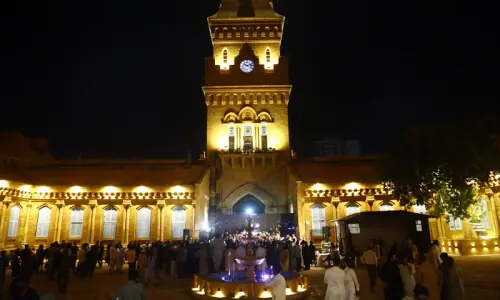
IF you've not visited this area, Lady Luck hasn't smiled on you. This is Karachi at its vintage best. There's history to be explored all around Chand Bibi Road. In fact, Chand Bibi herself is an alienable part of our collective consciousness, if it's the same 16th century Bibi who was a combatant, a polyglot and a sitar player. Perhaps it's not. What's to be considered is a variety of magnificent buildings on both sides of the two-way road, made in all kinds of classical and neoclassical styles, speaking volumes for what the city was meant to be and what it has metamorphosed into. In spite of the cold-blooded targeted killings and utter disdain for times past witnessed in this neighbourhood on a regular basis, Chand Bibi Road in the Bohrapir region has all the reasons for convincing the most forward-looking of men to have a taste of nostalgia.
The journey begins from a remarkable building as Chand Bibi Road unveils a string of once brilliant and now only noteworthy examples of architecture. It's the Civil Hospital Karachi's Burns Centre. The first thing that strikes you about the structure is its windows. They give off a Gothic vibe. The stone used in the construction still looks sturdy and the signs of wear and tear are less apparent. Additions have been made to the edifice which can be groused about. What difference would that make?
Moving from this point to the other end of Chand Bibi Road is like walking along the corridors of history. One after another there are sizeable buildings that have nothing to do with contemporary forms of structural design. Tinwalla Building is the first major piece on the left side. It is primarily a residential facility with, as is the norm, shops on the ground floor. Shabbily maintained, the building is still breathing comfortably.
It is tempting not to wander away from the thoroughfare and stroll into the winding lanes. It always pays. There's a vacant (or it gives such an impression) building on top of whose outer wall is written: Anjuman Taraqqi-i-Urdu. Stop. Isn't it where Baba-i-Urdu Maulvi Abdul Haq worked day in and day out to promote and improve the Urdu language? Isn't he buried here? Indeed, he is. The building seems to be undergoing a nip-and-tuck job. Enter it and look left. The gravesite of the great scholar is the only part of the structure that doesn't appear to be in need of restoration. The tombstone reads: Baba-i-Urdu Maulvi Abdul Haq Aug 20, 1870 – 16 Aug, 1961. Step inside the structure and you can tell that it is being redone, albeit at a snail's pace.
After paying homage to Abdul Haq, it's time to return to Chand Bibi. Feast your eyes on Hiralal Building, which is followed by a residence all painted in white but definitely a pre-independence construction. It has worth mentioning decorative features. Surprisingly whoever resides in it has kept it in a reasonably good shape.
A little ahead is the Government College for Women. This is another fine work of stonemasonry which has existed since the former half of the 20th century. It was originally constructed as a school, which later on assumed different statuses and is now a known girls' college of the city. It's a lovely building with big columns that can't be readily noticed from the outside because the institution has a boundary wall, making it difficult for strangers to walk into it easily, understandably so. A commemorative plaque on one of the walls reads: “Built by Seth Rampartap Ramachandra.”
On the contrary there's another institution (well, sort of) a few yards away — a boys hostel for a medical college students. Again, it's a large structure like the rest of the above-mentioned buildings. It is in an appalling state. Even a cursory look will suggest that it hasn't been cleaned, leave aside restored, for several years. The damaged facade and nothing-to-write-home-about interior of the facility need immediate attention. By the way, if you look hard and are able to read what's written just below the roof of the hostel, you'll observe it was erected as Haribhai Pragji Karia High School.
The thirst for digging out gems doesn't end with the hostel. Moving forward will enable you to see Khoda Building and across the road, on the right side, is a weirdly eye-catching construction that the locals call Naulakha Compound. It is a ground-plus-one building with interesting woodwork being the highlight of its upper storey.
Architect and conservationist Anila Naeem says: “Chand Bibi Road was formerly known as Princess Street. I don't know which princess the street was dedicated to. The compound you've been to has green wooden jaffris the likes of which were quite common in the old Saddar region. The buildings in this zone are of hybrid nature with some made in Italian Renaissance style. These structures had Hindu and Muslim owners. The Burns Centre was originally a nurses' hostel; the profile of the building's two-point arches is quite different because of its verticality. Otherwise the same pilasters, semi-circular arches with roundels and emphasised keystones and column capitals are the regular architectural characteristics in this area.”
Chand Bibi, the unknown princess, Maulvi Abdul Haq… do they have anything in common? Yes: the subcontinent's history.
mohammad.salman@dawn.com