0
0

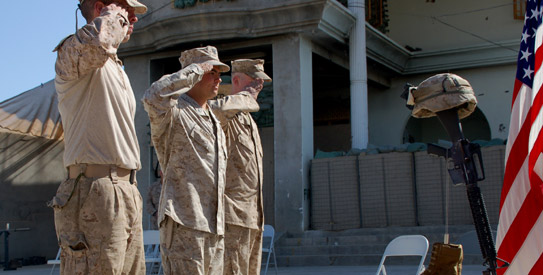
SANGIN, Afghanistan: Five months ago, when US Marines took over this sandbagged outpost in Sangin, deep in southern Afghanistan's Taliban country, they were pounded by insurgent fire every time they stepped foot off base.
Since Colonel Jason Morris's Marines replaced British soldiers at Forward Operating Base Sabit Qadam last fall, 29 of his men from the Marine 3rd Battalion, 5th Regiment, have been killed.
Another 175 have been wounded, giving the unit the dubious record of suffering the most casualties in the Afghan war.
“This was just an island in a sea of insurgency for a long time,” Morris said of the tiny outpost, flanked by poppy farms in the north of Helmand province.
The region promises to be a key battleground as foreign forces brace for an expected Taliban counter-attack this spring.
“Sangin is crucial because it is the last major stronghold of the Taliban in Helmand and is the final obstacle to routing the Taliban in their southern stronghold,” said Jeff Dressler, a Marines expert at the US-based Institute for the Study of War.
US commanders are now hoping that Sangin, like Marjah to the southwest, will become a model for what they say President Barack Obama's surge of 30,000 troops has done to weaken the Taliban almost ten years into the war.
US commanders in Sangin say they have killed or captured about 500 insurgents in the last five months. The Taliban have also been deprived, they say, of materials used to make roadside bombs, and locals are feeding US forces more tips.
They have pushed out into areas where British and Afghan forces did not go, far from the main highway bisecting Sangin.
They have put surveillance balloons in the sky that can help them snare insurgents.
“The closer you are to this fight the better it looks,” said US Defence Secretary Robert Gates, who toured parts of southern Afghanistan, including Sangin, on Tuesday as he assesses how many troops to pull from Afghanistan under a drawdown due to begin in July.
Transit route for drugs
Yet it remains to be seen whether foreign troops can fend off the Taliban this spring in an area that remains so dangerous that the top district official lives alongside Marines on the US base, and only ventures into town with armed protection.
Bloodshed remains widespread in the south, where government is still weak, the economy is depressed and serious questions remain about whether local forces can protect ordinary Afghans once Nato troops go home.
The insurgency, meanwhile, has spread to previously peaceful areas of the north and west.
Even Gates, who called improving security in Sangin “a major strategic breakthrough”, is uncertain about the area's future.
Military commanders hope such a breakthrough, if it can be crystallised, will allay impatience in the US Congress at the state of the war and buy the administration more time as Afghan forces inch closer to being able to take over security.
Sangin's location, along a dry river valley, is an important transit route for weapons, drugs and militants crossing into neighbouring Kandahar. At one point, Morris said, half of the illicit funds going to senior Taliban leaders across the border in Quetta, Pakistan, came through the Sangin area.
Roadside bombs remain the primary threat in the area, where some 150 improvised explosive devices (IEDs) have detonated since the US Marines arrived. Another 750 have been found.
Morris said there were already indications the Taliban were moving bomb-making materials back into Sangin and planning a counter-attack when “the leaves were back on the trees”.
“Fighting this spring will be intense as Marines push out from their already secure areas and the Taliban try to keep hold of their remaining areas of refuge,” Dressler said.
The biggest question, however, is the sustainability of such gains once foreign forces eventually withdraw from southern Afghanistan, where local officials remain under attack from militants and poverty is deep and enduring despite years of aid work.
US officials say the Taliban are certain to target Afghans supporting the government or foreign forces — another weapon in their bid to reclaim Helmand.
Lisa Curtis, an analyst at the Heritage Foundation in Washington, cautioned against rushing for the exit.
“The US military strategy in Afghanistan is just beginning to pay dividends and it would be a mistake to pull back troops until it is clearer the gains are more solid and sustainable,” she said.