0
0

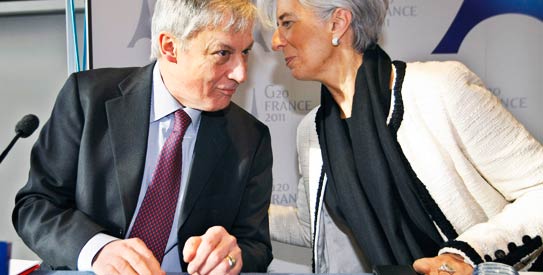
WASHINGTON: Nothing like a little revolution to shake up an already turbulent global economy.
World finance chiefs head to Paris for a Group of 20 nations meeting on Friday and Saturday after weeks of preparatory discussions by their aides on topics such as global economic imbalances and the euro zone's debt troubles.
Now, Egypt's historic popular uprising could force them to debate broader geopolitical matters as well.
“It's broken a psychological barrier not just for North Africa but across the Middle East,” said Anthony Skinner, an analyst at Maplecroft, a political risk consultancy. “You could see some contagion in terms of protests; Morocco, perhaps Jordan, Yemen.”
What happens next after the overthrow of President Hosni Mubarak? Could the unrest spread to other countries? What are the implications for global growth?
Answers will not be immediately forthcoming. After the jubilation in Cairo, it is impossible to know what the next phase of Egypt's political transition will bring.
That is likely to keep pressure on financial markets, the recovery of which has underpinned hopes for US economic growth.
“There isn't any greater visibility. We know what we don't have, which is Mubarak, but we don't know what we do have,” said Julian Mayo, investment director at Charlemagne Capital.
Another prominent subject for economy watchers around the world is inflation, particularly with a report on US consumer prices due on Thursday.
A two-speed global recovery, with emerging markets racing ahead as the developed world stumbles forward, has led to vastly divergent paths of inflation and plenty of trading of blame between governments for each other's economic problems.
In particular, policymakers in key economies like South Korea and Brazil have charged the Federal Reserve's ultra-low interest rate policy with artificially boosting their currencies and making exports less competitive.
Conversely, the Fed argues China's unwillingness to let its currency float means it -- not the US central bank -- is responsible for the excessive foreign exchange adjustments taking place in other countries.
If recent history is any guide, the G20 communique is unlikely to offer concrete progress on addressing a perceived shortage of savings in rich countries, coupled with weak domestic spending in emerging nations.
Analysts expect some headway by selecting key indicators that can help policymakers identify imbalances early.
DE-INFLATION
Some economists, including top Fed officials, have blamed such imbalances for the US financial crisis, saying cash from Asia flooding into US markets helped keep long-term borrowing costs excessively low.
In the aftermath of a deep recession, however, the country now has the opposite problem: how to address inflation that policymakers deem too low for comfort and an unemployment problem that is abating far too slowly.
That task is complicated further by a recent spike in commodity and energy prices that has grabbed headlines by pushing up the cost of staple goods like gasoline and food, and creating a very real inflation threat for emerging countries.
The US consumer price index is expected to have risen 0.4 per cent in January, but just 0.1 per cent when food and energy are stripped out, which Fed officials prefer.
“Core inflation is trending downward by some measures, but we think a turning point is at hand,” said David Greenlaw, economist at Morgan Stanley.
Other reports should confirm that a recent spurt of stronger economic activity may have more legs than pessimists believed. Retail sales are seen jumping 0.5 per cent in January following a 0.6 per cent gain in December. Industrial output, for its part, is forecast to rise 0.5 per cent following December's 0.8 per cent increase.
Whether that level of activity can persist, given expectations for budget cuts this year, remains to be seen.