



 0
0

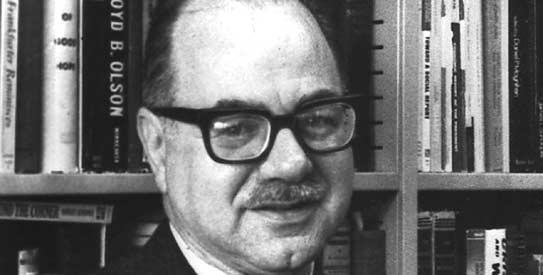
NEW YORK: Daniel Bell, a leading sociologist of the past half-century who wrote groundbreaking books about the demise of revolutionary politics and about the economy and lifestyle of what he helped label a ''post-industrial'' society, has died. He was 91.
Bell died Tuesday at his Cambridge, Massachusetts, home after a short illness, said his son, David Bell.
Daniel Bell was a teen radical who in middle age became an apostle of pragmatism. He is credited for at least two seminal works: ''The End of Ideology,'' which predicted a post-Marxist, post-conservative era, and ''The Coming of the Post-Industrial Society,'' in which he prophesied the shift from a manufacturing economy to one based on technology.
''Many people would testify to his influence, and I am one of those,'' said Nathan Glazer, his longtime friend and fellow sociologist. ''He always had large ideas. He was enormously energetic and had an amazing memory of names and dates. And some of his ideas about what was happening to society were very much on target.''
Bell's other books included ''Work and Its Discontents,'' ''The Reforming of Education'' and ''The Cultural Contradictions of Capitalism,'' which explored how a bourgeois economy coexisted with an anti-bourgeois culture.
For decades, Bell was a public intellectual, a ''New York intellectual.'' He was a widely quoted essayist; a co-editor of The Public Interest, a founding neo-conservative journal; and a professor of sociology at Harvard University and Columbia University, where he helped mediate a campus rebellion in 1968.
Although Bell was linked politically to Public Interest co-founder and neo-conservative ''godfather'' Irving Kristol, he left the magazine after a few years and followed no single line of thinking.
He believed in free elections and a regulated economy, but also valued cultural and moral tradition and scorned contemporary art. He defined himself as a liberal in politics, a socialist in economics and a conservative in culture.
His story was archetypal: The son of Jewish immigrants, his first language Yiddish and first religion politics. Growing up poor on Manhattan's Lower East Side, his father having died when Bell was 10 months old, made him a dedicated socialist at age 13.
''When I had my Bar Mitzvah,'' he once recalled, ''I said to the Rabbi, 'I've found the truth. I don't believe in God ... I'm joining the Young People's Socialist League.' So he looked at me and said, 'Kid, you don't believe in God. Tell me, do you think God cares?'''
By his teen years, he knew English well enough to read Marx and John Stuart Mill and study dialectical materialism. At City College of New York, he received a degree in sociology, but otherwise was steeped in debates with classmates Irving Howe, Kristol and Glazer, their gatherings recalled in the 1998 documentary ''Arguing the World.''
After graduating from CCNY, Bell briefly attended Columbia as a graduate student but dropped out to write for the liberal journal The New Leader, where he soon became managing editor. In the 1940s, he taught at the University of Chicago and served as labor editor of Fortune Magazine.
Skeptical of Marxist formulas, he was more of a ''socialist,'' with a small ''s,'' than a Socialist. His first book, ''Marxian Socialism in the United States,'' was an exploration of why a Marxist revolution never occurred in the US, even during the Great Depression. His conclusion: Socialists were too rigid, too programmed, for what was an essentially unprogrammed country.
He was married three times, most recently, in 1960, to literary critic Pearl Kazin, who years earlier had been involved with poet Dylan Thomas.
''He was a terrific father, a wonderful friend and a generous individual,'' his son said Wednesday. ''He was an extraordinary talker with a huge range of jokes, that he called stories, that he'd deliver with perfect timing. He was always able to hold everyone's attention.''
He is survived by his wife, son, daughter Jordy Bell, and four grandchildren. A private burial service is planned for Friday, his son said. A memorial service in the spring is pending.


























