0
0

BEIRUT: Hezbollah-backed billionaire Najib Mikati has been named Lebanon’s prime minister-designate, giving the Shiite militant group increased clout in the deeply divided nation and sparking angry protests.
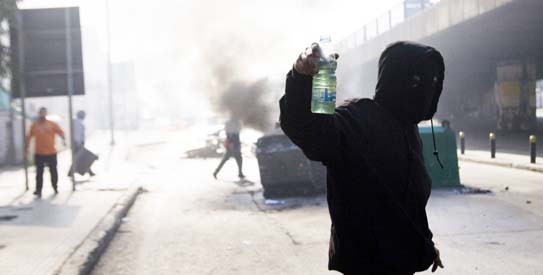
President Michel Sleiman asked the tycoon Tuesday to form a government amid a “day of rage” by fellow Sunnis who blocked roads and burned tyres in anger at his nomination, prompting France and the United States to voice concern.
The US accused the Iran- and Syria-backed Hezbollah of wresting government control by force, and vowed that a UN-backed tribunal trying the killers of former prime minister Rafiq Hariri – which Hezbollah has been accused of trying to fend off – would press on with its work.
Mikati shortly after his appointment rejected attempts to cast him as “Hezbollah’s man” and said he would cooperate with all Lebanese to form an inclusive government.
“Don’t prejudge me or my behaviour, please, especially the international community,” the 55-year-old told AFP in an interview.
“I say in all honesty that my nomination by Hezbollah does not mean I am bound by any of their political positions, except as concerns the protection of the national resistance,” he said, referring to the Shiite militant group’s struggle against neighbouring Israel.
Hezbollah and its allies brought down the government of the Western-backed Saad Hariri, Rafiq’s son, on January 12 after a long-running standoff over the UN-backed probe into the senior Hariri’s 2005 assassination.
The militant group has said it believes some of its members will be indicted by the Netherlands-based Special Tribunal for Lebanon, which it has denounced as part of a US-Israeli conspiracy.
“The make-up of Lebanon’s government is a Lebanese decision, but this decision should not be reached through coercion, intimidation and threats of violence,” US State Department spokesman Philip Crowley said in a statement.
“Unfortunately, Hezbollah, backed by Syria, engaged in all three in pursuit of its political goals,” he said.
“The work of the Special Tribunal for Lebanon is of vital importance to stability, security and justice in Lebanon. Its work will continue,” Crowley’s statement added.
Mikati, who is close to Syria and is considered a moderate, earlier told reporters that he would reach out to all parties in forming his government.
Hezbollah leader Hassan Nasrallah echoed him, saying: “The new government will not be a Hezbollah government nor will it be led by Hezbollah ...We don’t want power.”
Protests had turned violent in the northern Sunni bastion of Tripoli, where frenzied demonstrators torched an Al-Jazeera van and ransacked offices of a local Sunni lawmaker who backed Mikati.
Demonstrators also blocked roads in several other areas, including the capital Beirut, the southern coastal city of Sidon and the eastern Bekaa region.
There were no immediate reports of any casualties, a security official told AFP.
Mikati’s appointment has angered Sunnis who see it as a bid by Hezbollah to sideline outgoing pro-western premier Hariri and impose its will in Lebanon.
According to Lebanon’s power-sharing system, the country’s prime minister must be a Sunni.
“I am a Sunni Muslim and I refuse to allow anyone to impose their candidate for premiership on our community,” said Um Khodr, 50, who was among thousands of demonstrators in Tripoli.
“We will remain in the streets until the traitor Mikati leaves the post.” Mikati told AFP that he would seek to address the thorny issue through dialogue.
“Stopping the tribunal today is no longer a Lebanese decision,” he said, adding that Lebanon’s cooperation with the tribunal was another question altogether. He did not elaborate.
The United States, which continues to blacklist Hezbollah as a terrorist organisation, warned that a Hezbollah-controlled government would affect bilateral ties.
“A Hezbollah-controlled government would clearly have an impact on our bilateral relationship,” US Secretary of State Hillary Clinton told reporters.
She said Washington was following “closely and carefully” developments in Beirut and harboured “deep concerns about the influence of outside forces.”
Former colonial power France expressed “concern for the stability” of Lebanon and called for Mikati to form a government without outside “interference.”