0
0

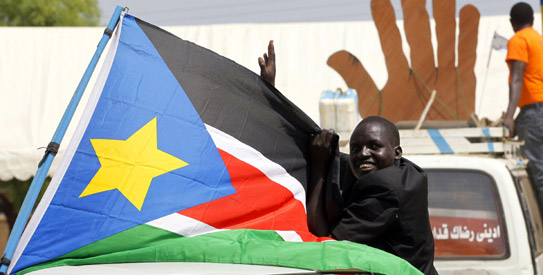
JUBA, Sudan: The referendum is known as "The Final Walk to Freedom" — a symbolic journey for those who fought in decades of war, for villagers whose homes were bombed, and for orphans who ended up in US communities as the Lost Boys of Sudan.
The weeklong independence balloting starts Sunday for the southern third of Sudan — Africa's biggest country — on whether to draw a border between the north, which is mostly Arab and Muslim, and the south, populated mostly by blacks who are Christian or animist.
For southern Sudanese like Atem Yak, who survived war, lived amid dire poverty and endured discrimination, it has been a long time coming.
Yak was five when Sudan gained independence from Britain in 1956. Yak, now 60, remembers when two dozen chiefs died in attacks in his home village of Kongor in the 1960s. In Sudan's capital, Khartoum, Yak's deep black African skin incited mistreatment.
"I never saw the flag of Sudan as something I owed allegiance to," he said. "The national anthem never represented my will. So I will not shed tears when Sudan breaks into two, provided that this is done peacefully. I will be happy."
Southerners in Juba were not just happy — they were ecstatic Friday as they anticipated the vote. Wearing feathers and grasping ceremonial carved sticks, they danced on dirt streets in a growing city that will be the south's future capital if the referendum passes. They pounded on drums and sang chants for independence.
Southern Sudanese will cast simple, illustrated ballots at polling stations under thatched roof shelters in the remote and impoverished countryside and near newly paved roads in Juba, a city of simple concrete houses and mud huts that got its first paved roads only in recent years.
Yak is educated and wealthy enough to own a car, a rarity in a region where half the people rely on food aid, only 15 per cent can read and children die for want of basic medicine. Yak sees the referendum as an opportunity for the African residents of Sudan, who are often denied resources in favour of northern Arabs.
A sharp economic divide lies between the regions, with infrastructure development and government programs heavily weighted to the north. Only two per cent of southerners complete primary school while 21 per cent in the north do. The south, which is the size of France, has only 30 miles of paved roads. The north has 2,200 miles.
The top US official in Southern Sudan, Barrie Walkley, said the lack of paved roads made getting polling materials to the sites "remarkably difficult," and that helicopters and motorcycles were used. People also carried the material over long stretches in the many areas where no roads exist.
The US has made the referendum a foreign policy priority and has offered to remove Sudan from the list of state sponsors of terror if Khartoum doesn't hinder the vote, which would create the world's newest country.
The 1983-2005 civil war killed an estimated two million people and left many others missing one or more limbs. The presence of these victims throughout the south is a testament to the horrors of the conflict.
More than one million people headed north to escape the fighting, and about 3,800 war orphans known as the Lost Boys of Sudan resettled in the US. Some of those orphans will join thousands of other Sudanese to vote at polling sites set up in eight US cities.
Dolly Odwong, 45, remembers Russian-made planes bombing the southern capital, which mostly held women and children because the men were out fighting.
"The coming generation will not feel the way we felt. We don't want them running the way we were running and hiding, because when the war started everybody had to run and hide," Odwong said. "Life was very difficult, and people were saying 'God, why us?' That was the question. So now we are thinking that God has heard our prayers. And he is saying 'You people are going to be free.'"
Choosing secession, the south's ruling party tells voters in a pamphlet, will "fulfil the dreams and aspirations of your forefathers, heroes, heroines and martyrs who died in the struggle for freedom."
For the referendum to pass, a simple majority must vote for independence and at least 60 per cent of the 3.9 million registered voters must cast ballots.
"Like all other observers I think the referendum will likely produce an overwhelming vote for secession," said Zach Vertin, a Southern Sudan analyst for the International Crisis Group.
If the referendum passes, much work remains. The north and south must reach agreements on the distribution of oil revenues, rights to the White Nile, official borders and citizenship rights. Aid groups fear that southerners living in the north and northerners living in the south will face harassment and abuse.
"At this point, it appears the referendum itself might come off relatively peacefully," said Mike Abramowitz, who leads the US Holocaust Memorial Museum's genocide prevention efforts. "But this is just a first step. This remains a fragile and volatile situation, and the danger will come in the months ahead as the world turns its attention to other matters."
For his part, Yak agrees that "The Final Walk to Freedom" will open a new path on which the quality of life for southerners can be improved as they take command of their own future.
"When you are free...it should be a means to promote the welfare of others," Yak said.
"To me, independence is not an end, it's a means. The struggle will start the day independence is declared."