0
0

NAJAF: A fiercely anti-American Shiite cleric who heads Iraq's most feared militia has returned after nearly four years in self-imposed exile, to the jubilation of supporters and the dismay of many other Iraqis who remember the sectarian killings carried out by his dreaded death squads.
Muqtada Al-Sadr's return to Iraq on Wednesday solidified the rise of his movement and ensured he will be a powerful voice in Iraqi politics as US forces leave the country. He left Iraq in 2007 somewhat as a renegade, a firebrand populist whose militiamen battled American troops and Iraqi forces. He returns a more legitimized figure, leading an organized political movement that is a key partner in the new government of Prime Minister Nouri al-Maliki.
Al-Sadr can wield a bully pulpit to put strong pressure on al-Maliki, and is likely to demand that no American troops remain beyond their scheduled final withdrawal date at the end of this year.
For many Iraqis, especially the minority Sunnis, al-Sadr and his Mahdi Army will always be synonymous with the vicious sectarian killings they are blamed for carrying out during the worst of the sectarian violence in 2006 and 2007.
In the Azamiyah neighborhood that used to be a favorite target of the death squads, Ahmed al-Azami, a 43-year-old lawyer, said people feared the militia would once again become active. He described al-Sadr as little more than a tool of Iran.
But the fiery preacher has legions of followers among Iraq's poorer classes who see him as a champion of their rights against both the Sunnis who dominated Iraq under Saddam Hussein and other Shiite political parties such as al-Maliki's Dawa party, which represents more of the Shiite middle class.
''He is our hero. We sacrificed for him. He said 'No' to the Americans and fought the Americans, and he is brave,'' said Mohammed Ali, one of the hundreds who turned out to greet al-Sadr in the Shiite holy city of Najaf, south of Baghdad.
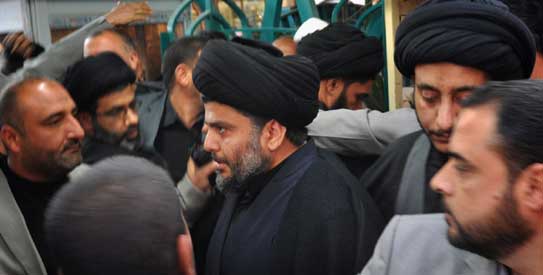
Al-Sadr visited the holy shrine of Imam Ali, revered among the country's Shiite majority, wearing a black turban distinguishing him as one of the descendants of Islam's Prophet Muhammad. A phalanx of bodyguards that surrounded him tried to hold back a throng of supporters.
He also visited the grave of his father, who was assassinated during Saddam's rule, before heading to his house. Dozens of black-clad Mahdi Army members spread out through the neighborhood surrounding his home.
Al-Sadr and his followers have parlayed their street credentials earned from battling US forces and a savvy political organizing ability into 40 seats in the 325-member parliament during last March's election. Their grudging support for al-Maliki secured him a second term.
''The American occupation was always a useful rallying point but his objective is power in Iraq,'' said Joost Hiltermann from the International Crisis Group.
US State Department spokesman P.J. Crowley said Washington hoped al-Sadr's party would ''play a constructive role'' in the Iraqi government, but added, ''What he actually does, I'm not sure I can predict.''
Asked if the US was concerned al-Sadr might instigate violence, Crowley replied, ''That would be tragic for Iraq. And that's one of the reasons why we've worked so hard to build up the capability of Iraqi security forces to handle whatever challenge to the government occurs.''
Al-Sadr had not been seen publicly in Iraq since he left in 2007 to study Islam in Qom, the seat of Shiite education, to burnish his religious credentials. He also faced an arrest warrant for his alleged role in assassinating a rival Shiite cleric.
The arrest warrant appeared to be in effect as recently as last March. But the chances it would be enforced appear highly unlikely considering the alliance between al-Maliki and al-Sadr. The public nature of al-Sadr's return _ his first appearance in Iraq since leaving for Iran _ suggested he had little to fear.
Al-Sadr's return came on the same day that the Iranian foreign minister made his first visit to Iraq. During a visit to Najaf, the Iranian ambassador, Hassan Danaie, praised al-Sadr.
''His presence will serve stability in Iraq,'' the ambassador said.
An official from the Sadrist office in Najaf said al-Sadr's return was permanent. He spoke on condition of anonymity because he was not authorized to speak to the media, and al-Sadr made no public comments.
Enmity between al-Sadr and al-Maliki runs deep.
Al-Maliki in 2008 launched an offensive against al-Sadr's followers in Baghdad and the southern city of Basra. The show of force infuriated many of his Shiite allies but also demonstrated al-Maliki's willingness to go after all militias, even those representing his own sect.
But al-Sadr eventually backed al-Maliki for a second term after protracted negotiations following the March elections, likely owing to intense pressure from Iran and in return for concessions. – AP