0
0

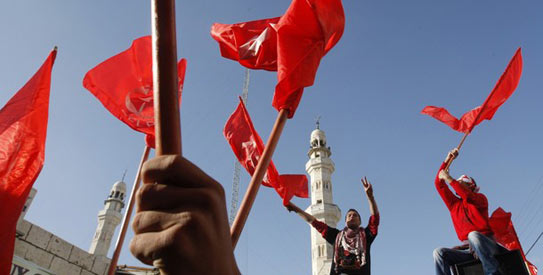
JERUSALEM: Disillusioned by the collapse of talks and disappointed by the US administration, the Palestinians are turning away from negotiations and seeking international recognition for a Palestinian state.
In the days since the US administration acknowledged it had failed to chart a path back to direct peace talks between Israel and the Palestinians, senior Palestinian officials have made clear that they think negotiations are dead.
“The peace process is in a deep coma,” Palestinian negotiator Nabil Shaath told journalists Saturday night. “I don't think anyone wants to continue this negotiation. There is no more credibility to this negotiation process. This is an exercise in futility -- ridiculous.”
US Secretary of State Hillary Clinton has pledged the United States will seek to push peace talks forward through indirect negotiations facilitated by Washington, but Shaath rejected talks without a frame of reference.
“I don't think we are to resume the negotiations soon,” he said, echoing sentiments expressed by other senior Palestinian officials.
Direct talks between Israel and the Palestinians, the first for nearly two years, began in Washington on September 2. But they quickly stalled, when a 10-month Israeli settlement freeze expired on September 26.
The Palestinians refused to resume negotiations without a new moratorium, but Washington admitted last week that it had failed to convince Israel to renew the building ban, despite offering a generous package of incentives.
Palestinian president Mahmud Abbas said Sunday he could not understand how Israeli premier Benjamin Netanyahu had chosen settlement building over peace.
“He chose settlements over peace,” Abbas told a visiting group of Israeli lawmakers and activists, including left-leaning members of the Knesset.
“I don't understand choosing settlements as more important than peace for us and for the coming generations,” Abbas said, questioning Netanyahu's priorities.
Clinton has proposed resuming talks in an indirect manner, with the key issues of borders, refugees and Jerusalem all on the table.
But the Palestinians, supported by the Arab League, have signalled a lack of faith and patience, insisting they will not resume negotiations without a settlement freeze and pressing the United States to make a “serious offer.” “The negotiating process is totally useless without terms of reference,” Shaath said.
The Palestinians have said they want any new talks to be explicitly based on the goal of ending the occupation and the creation of a Palestinian state along the June 1967 borders in place after the Six Day War, with east Jerusalem as its capital.
In the absence of talks, and unconvinced that a US administration with domestic problems and a looming election campaign, can deliver on its promises, the Palestinians are considering other options.
Palestinian prime minister Salam Fayyad on Saturday said the leadership would not unilaterally declare independence, even if they do not reach a peace deal with Israel.
“What we're looking for... is a state of Palestine, we're not looking for yet another declaration of statehood,” he told Israel's Channel Two television.
“We're not looking for a Mickey Mouse state, we're not looking for some form of self-rule, we're looking for a sovereign state of Palestine, where we Palestinians can live as free people.”The Palestinian leadership is seeking international recognitions of statehood, and has already attracted support from countries including Brazil, Argentina and Bolivia.
“We have devoted ourselves to negotiations for nearly two decades and today we are trapped in a framework that thus far has not lifted the occupation,” chief Palestinian negotiator Saeb Erakat said on Friday.
“Unlike the Israeli government, which is comfortable with the status quo of occupation and continued colonisation, the Palestinian people must seek their freedom through any peaceful channel available to us.” Brazil, Argentina and Bolivia have already announced their recognition of a Palestinian state along the 1967 borders, and Uruguay has said it will do so next month. Several other Latin American countries are expected to follow suit.
On the European front, the Palestinian Authority is seeking to upgrade its presence to the level of diplomatic representation, and has already done so in France, Spain, Portugal and Norway.
The Palestinians also are set to appeal to the United Nations Security Council for a resolution to halt Israeli settlement construction, which is regarded as illegal under international law. – AFP