0
0

VIENNA: Iran's nuclear program has suffered a recent setback, with major technical problems forcing the temporary shutdown of thousands of centrifuges enriching uranium, diplomats told The Associated Press on Monday.
The diplomats said they had no specifics on the nature of the problem that in recent months led Iranian experts to briefly power down the machines they use for enrichment _ a nuclear technology that has both civilian and military uses.
But suspicions focused on the Stuxnet worm, the computer virus thought to be aimed at Iran's nuclear program, which experts last week identified as being calibrated to destroy centrifuges by sending them spinning out of control.
Iran says its enrichment efforts are geared only to make nuclear fuel but the program has aroused international concern because it can be re-engineered to produce uranium for nuclear warheads.
There have been hints that the program is beset by technical problems. Even a brief shutdown of the thousands of enriching machines would be the strongest documentation to date that the program _ Iran's nuclear cornerstone and a source of national pride _ is in trouble.
The country has continued to enrich despite increasingly strict UN sanctions imposed in reaction to its nuclear defiance and has stockpiled enough material for more than two nuclear bombs should it choose to turn it into weapons-grade uranium.
Unease has been fed by Tehran's refusal to accept nuclear fuel from abroad, the covert origins of its enrichment activities and stonewalling of efforts by the International Atomic Energy Agency to probe allegations that it tried to develop components of a nuclear weapons program.
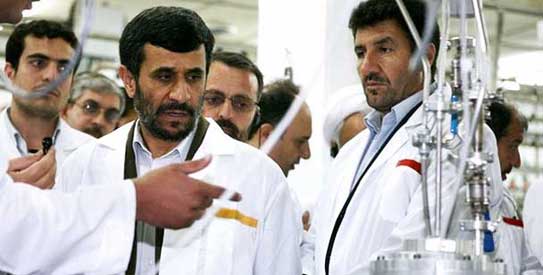
Since being revealed eight years ago, Iran has expanded its enrichment activities to the point where it now runs about 8,500 centrifuges at Natanz, in central Iran. But after initial rapid growth, Iranian enrichment capacity has stagnated in recent years. Tehran has taken hundreds of centrifuges off line over the past 18 months, prompting speculation of technical problems.
A UN official close to the IAEA said a complete stop in Iran's centrifuge operation would be unprecedented to his knowledge but declined to discuss specifics. He, like two senior diplomats from IAEA member countries who told the AP of the incident at Natanz, asked for anonymity because the information was confidential.
The three officials spoke on the eve of the planned release of a confidential IAEA update on Iran _ the latest report by the Vienna-based agency to its 35-nation board on its attempts to get an overview of Tehran's nuclear activities. The diplomats said it would again focus on Tehran's refusal to heed UN Security Council demands to stop enrichment.
That report will come less than three weeks before planned talks between Iran and the world's five powers _ the US, Russia, China, Britain, France and Germany _ designed to reduce concerns about Tehran's nuclear agenda.
Iran's enrichment program has come under renewed focus with the conclusion of cyber experts and analysts that the Stuxnet worm that infected Iran's nuclear program was designed to abruptly change the rotational speeds of motors such as ones used in centrifuges. Such sudden changes can crash centrifuges and damage them beyond repair.
No one has claimed to be behind Stuxnet, but some analysts have speculated that it originated in Israel.
The worm ''specifically controls frequency converter drives'' that normally run between 807 Herz and 1210 Herz, researcher Eric Chien of the computer security company Symantec, said in an e-mail to the AP. ''These are subsequently changed to run at 1410Hz, then 2Hz, and then 1064Hz.''
Iran nuclear expert David Albright said it was impossible to say what would cause a disruption strong enough to idle the centrifuges but ''Stuxnet would do just that.
''It would send (centrifuge) speeds up and then suddenly drop them,'' said Albright of the Washington-based Institute for Science and International Security, which has tracked Iran for signs of covert proliferation.
Albright and a colleague, Andrea Stricker, last week released a study applying Chien's finding to centrifuges. He said the worm appeared capable of pushing centrifuge speeds above their normal speeds, up to 1,410 Herz, or cycles per second, and then suddenly dropping speeds to 2 cycles per second, disrupting their operations and destroying some in the process.
Separately, another official from an IAEA member country suggested the worm could cause further damage to Iran's nuclear program.
The official also asked for anonymity because his information was privileged. He cited a Western intelligence report suggesting that Stuxnet had infected the control system of Iran's Bushehr reactor and would be activated once the Russian-built reactor goes on line in a few months. – AP