0
0

WASHINGTON: What if airport screeners looked at would-be passengers and instead of assessing the color of their skin, asked: “What’s the square root of your likelihood of being a terrorist?”
Such is the world imagined by an American computer scientist who argues that racial profiling to root out potential terrorists is actually less effective than random searches, but says some simple math could offer a better solution.
“When you have any profiling at all, it quickly becomes less effective than random sampling,” said University of Texas professor William Press, whose paper appears Wednesday in the journal Significance, a publication of Britain’s Royal Statistical Society.
Profiling does not work because “you end up screening the same innocent people over and over again, just because they happen to be in a profiled group,” Press said.
Previous studies have shown that any apparent rise in success due to racial profiling is actually due to increased levels of law enforcement. More police focusing on one group will catch more criminals since fewer police and resources are focused on other groups.
“It is simply better to do uniform random sampling, which means everyone who shows up at the airport should have the same chance of being screened in the same way,” said Press, who has written on the topic before for the Proceedings of the National Academy of Sciences.
But he has come up with an idea that just might be even better.
“It is this thing called square root sampling,” he told AFP.
That way, screeners would approach a given group deemed to be, say 100 times more likely to be harmful, and then check them the square root of that number, or 10 times, more often.
“That actually would be better than uniform (random) sampling. The trouble is there is no good way to do that.”
Press teaches university-level statistics and uses the example for his students, who do not argue with his mathematical formulas but do puzzle over practical ways to solve the problem in real life.
“One could imagine a system in which people's risk factors are evaluated and as you show up in airport you know, in some computerized automatic way the computer flashes either red or green and does this square root business which would be some form of optimal profiling,” he said.
“But I don’t know anyone who actually thinks you could make such a system work.”
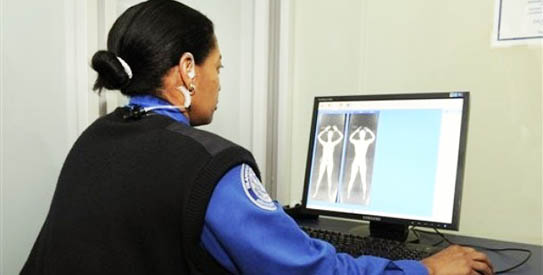
And when it comes to the latest controversy roiling US airport travelers – systems that can peer through clothing and show bodily details – Press has just one hope in mind for any new screening technology.
“That it not slow down the lines,” he said. — AFP