0
0

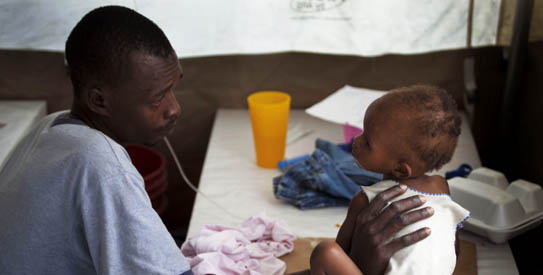
PORT-AU-PRINCE: Haiti’s cholera toll rose above 900 on Sunday, including dozens of deaths in the teeming capital, as the outbreak showed no sign of abating just two weeks ahead of presidential elections.
Health Ministry officials reported more than 120 new deaths since the previous toll, as authorities and international aid agencies struggled to contain the latest crisis afflicting the desperately poor Caribbean nation.
Nearly one month after cholera took hold, the confirmed fatalities rose to 917, up from Friday’s 796 recorded deaths.
The recent increase in fatalities has been steady and not a spike, but it nonetheless highlights the difficulties of tamping down an outbreak in a country desperate for better infrastructure and health services.
As concerns rise over massive health challenges in the aftermath of the country's cataclysmic earthquake almost a year ago, Haiti confronts the hardening prospect of national elections two weeks from now in the midst of a series of disasters.
Of Haiti’s 10 provinces, six now have been touched by the cholera epidemic according to the health ministry, which said 14,642 people so far have been treated in hospital, about 2,300 more than on Friday.
At least 27 of the deaths were recorded in the teeming capital Port-au-Prince, including its largest slum Cite Soleil and its suburbs.
Most of those treated already have been released, but a wave of new infections is swamping understaffed and ill-prepared hospitals and clinics across the country.
Officials fear the scale of the epidemic could increase exponentially if cholera infiltrates makeshift camps in Port-au-Prince where hundreds of thousands of earthquake survivors live in cramped and unsanitary conditions.
A cataclysmic earthquake flattened much of the capital in January, leaving more than a quarter people dead and an estimated 1.3 million of Haiti's 10 million population displaced.
Amid the crises, Haitians are due to vote for a new president and parliamentarians in late November.
Mirlande Manigat, the candidate who leads in polls ahead of the vote to succeed outgoing President Rene Preval, said it would be “unreasonable” for officials to postpone the election despite the crises.
“The general situation is not favorable for elections, because of the earthquake, health problems, cholera (and) hurricanes” among the pressing crises facing the country, Manigats told AFP.
But “we are now at a point when we cannot step back” from the election, “because there is a momentum within the population,” the former first lady and longtime opposition leader said.
Candidate Leslie Voltaire also urged authorities to hold the vote as scheduled on November 28.
“We can not postpone the election because of the cholera. You never know, if you postpone the election by a month or two, the cholera may be worse than it is today.”
The United Nations is asking for 164 million dollars to fight the epidemic, which has gained strength over the past week and spread to Port-au-Prince, and has warned that aid efforts could be “overrun by the epidemic” without urgent global financial assistance.
The bulk of the requested money – around 89 million dollars – will be used for water, sanitation and hygiene, while 43 million will be used for health, and 19 million for efforts in the camps housing people displaced by the earthquake, UN officials said.
Conditions were aggravated dramatically earlier this month when Hurricane Tomas brought heavy rains which caused rivers to burst their banks, including the Artibonite River, which is believed to be the conduit of the disease.
The Artibonite region in the northwest has been the hardest hit, with 595 recorded deaths.
The aid group Save the Children said 40 percent of those who have died in the epidemic were not in a hospital or clinic, suggesting they had no treatment or had not recognized symptoms of a disease that can kill within hours. — AFP