0
0

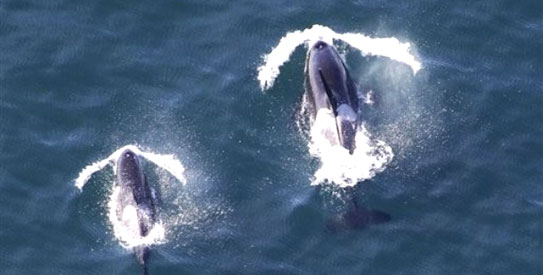
PARIS: A closely-studied community of whales, including the threatened blue whale, showed worrying signs of sunburn, possibly because of ozone depletion in the atmosphere, biologists reported on Wednesday.
Whales come to the surface to breath, socialise and feed their young, which means the skin on their backs is exposed to the full force of the Sun, sometimes for hours.
Scientists from the Zoological Society and University of London and Mexico’s Inter-disciplinary Centre of Marine Sciences studied around 150 blue whales, fin whales and sperm whales in Mexico’s Gulf of California between January and June in 2007, 2008 and 2009.
They took high-definition photographs and took skin samples using a stainless steel dart that were then examined under a microscope.
They found widespread signs of blister-type lesions similar to symptoms of sunburn among humans. These signs worsened over time, as would be expected with higher exposure to ultra-violet.
Worst affected were the whales that spent the most time in the Sun, and also blue whales which have paler skins compared with other species.
Ultra-violet levels in the Gulf of Mexico fluctuate between high and extremely high levels throughout the year.
“The increase in skin damage seen in blue whales is a matter of concern, but at this stage it is not clear what is causing this increase,” said Laura Martinez-Levasseur of the Zoological Society of London.
“A likely candidate is rising UVR (ultra-violet radiation) as a result of either ozone depletion or a change in the level of cloud cover.” The impact of the lesions on the whales’ health was not part of the research.
Ultra-violet light can cause potentially cancer-causing DNA damage to skin at high doses. It is filtered by clouds and also by the fine layer of ozone, a molecule of oxygen, in the stratosphere.
Ozone, though, has been badly attacked by chlorine-based chemicals that are now being phased out under the 1987 Montreal Protocol.
The depletion is global but worse in lower latitudes, as evidenced by the famous “ozone hole” that appears seasonally over Antarctica.
On September 16, a panel of 300 scientists, issuing a four yearly assessment under the UN banner, said the ozone layer would be restored to 1980 levels in 2045 to 2060, “slightly earlier” than expected.
Blue whales, the world’s biggest mammals, can measure up to 30 metres long and weigh upwards of 180 tonnes. – AFP