0
0

ISLAMABAD, Sept 11: A total of 164 observers from all 15 EU member states are due to be stationed throughout the country in the coming weeks to observe and determine the degree of freedom and fairness with which the Oct 10 election process is being conducted.
According to the mission sources, the observers would be guided in arriving at conclusions on the election process by the following seven criteria:
* The degree of impartiality shown by the Election Commission of Pakistan and election officials;
* The degree of freedom of political parties and candidates to organize, move, assembly and express their views publicly;
* The fairness of access to state resources made available for the election;
* The fairness of access for political parties and candidates to the media, in particular the state media;
* The manner in which registration of voters is conducted;
* Any other issue concerning the essential freedom and fairness of the election; and
* The conduct of polling and counting of votes.
These criteria are said to be universal and are applied by the EU mission wherever it is sent to observe the election process irrespective of the kind of democracy — ‘controlled’, ‘semi- controlled’ or ‘unfettered’— that is practised in a host country.
Political parties which have been accusing the government of indulging in massive pre-poll engineering sounded re-assured by the announcement of these explicit but all encompassing criteria.
One political party spokesperson said in the face of these preconditions for determining the freedom and fairness of the election process the government would find it increasingly difficult to continue with its attempts to influence the results of Oct 10 elections.
Another politician hoped that the EU observers would take due notice of the barefaced interference of the provincial governors and their chief and home secretaries as well as their respective IGs in the election process to obtain what he called ‘desired results’ of the polls.
“These activities directly violate a number of EU criteria,” he claimed.
It will help the EU mission to make more educated application of their criteria if political parties having specific complaints against the government and the Election Commission were to hold press conferences like the one held recently by Imran Khan to make public the evidence of discrimination and official interference in the process, maintained an opposition leader.
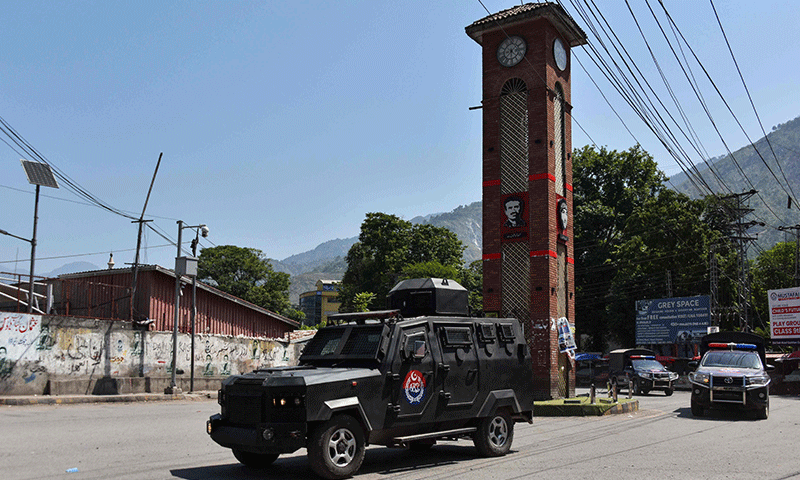
SECURITY: He said announcement of these criteria has already forced the government on the back-foot and that was the reason, according to him that despite the clear cut announcement by the mission team at the very start that it would only observe and not monitor the elections, statements were being issued by responsible Pakistani officials warning the team to confine its task to observation only and not to interfere with the election process “and one official even went to extent of cautioning the general public against the ‘motives’ of the observers whom he branded as hostile to Pakistan.”
Adding, he said, it was perhaps in order to discourage the EU teams from visiting the polling stations on the E-day that the federal government has expressed its inability to provide them with proper security cover.
“In fact to make their job that much more hazardous, the EU mission has been asked to make private security arrangements on its own,” he disclosed.
Disagreeing completely with the government’s excuse that the enormous additional demands on the election day on the already inadequate law and order machinery would make it impossible to cater to the security needs of the foreign observers on Oct 10, he asked: “Even if this is accepted as the truth then why can’t army jawans be pressed into service for the security of the foreign observers’ teams on the election day since it has already been decided not to use the army for the purposes of supervision of the elections?”
Meanwhile, it has been learnt that all provincial governments except Sindh have extended verbal assurances to the EU mission that the security of their teams would be looked after by the respective provincial law and order departments.
Political circles said since there is nothing on paper about the visit of the EU observers’ mission, the federal government could ignore its responsibility vis-a-vis the safety of foreign visitors without the fear of being made answerable.
“EU was not requested in writing by the government to send its mission to Pakistan to observe the Oct 10 election process, nor has Islamabad signed any Memorandum of Understanding (MoU) with the mission on its terms of reference for the job as was done by the Sri Lankan government when it officially invited the observers from Europe to observer their elections earlier this year,” they added.
The only invitation extended to the EU, according to these circles, was a verbal welcome President Gen Pervez Musharraf extended to the mission chief when he called on the President on his arrival in the country.
NO PUBLIC DISCUSSION: Mindful of the fact that any public discussion of the way the elections are being conducted before the completion of the process would help or harm the chances of one or the other contesting party, the EU mission has reportedly assured all the interested parties that it would avoid doing this until after the elections when it will submit a preliminary report to the European Union headquarters, followed by a final report on its findings.
The EU mission has set for its members the following code of conduct:
* Respect the laws of the land. Observers enjoy no special immunities as an international observer, unless the host country so provides; observers will carry prescribed identification issued by the host government or the Election Commission and will identify themselves to any interested authority upon request; observers shall maintain strict impartiality in the conduct of their duties and shall at no time express any bias or preference in relation to national authorities, parties, candidates, or with reference to any issues in contention in the election process; observers will not display or wear any partisan symbols, colours or banners; observers will undertake their duties in an unobtrusive manner, and will not disrupt or interfere with the election process, polling day procedures, or the vote count; observers may bring irregularities to the attention of the election officials, but will not give instructions or counter any decisions of the election officials; observers will base all conclusions on well-documented, factual and verifiable evidence, and will keep a record of the polling stations and other relevant places that they visit; observers will refrain from making any personal or premature comment about their observations to the media or any other interested persons, but should provide, through a designated liaison officer or spokesperson, general information about the nature of their activities as observers; observers must comply with all national laws and regulations.
The code further said where these limit freedom of assembly or movement about the country, they must note where such rules prevent them from carrying out their duties, at all times during the mission, including during private time away from work, each election observer should behave blamelessly, exercise sound judgment and observe the highest level of personal discretion.