0
0

KARACHI, Dec 27 Jobless and financially-strapped Khuda Gunj, the father of four children and a resident of a coastal village, suffered another setback when he had a serious motorbike accident.
One day when he was heading homewards in the evening, he fell from his motorcycle and received multiple injuries on a leg.
His friend riding pillion got cuts and bruises on his face and fainted. Luckily, some passers-by helped them and took them to their homes in Mubarik Village, an old settlement of fishing community situated in Keamari Town and very much part of Karachi.
Here, they remained without any first aid for almost an hour and 30 minutes. And the reason was that the only healthcare facility in the village had been closed down many years ago and no transport facility or ambulance service was available to take them to Mauripur, which is a 45-minute drive from Mubarik Village. It was the nearest place where medical services could be available.
After hectic efforts, some relatives hired a truck which took the injured to Mauripur where they had to be treated at a private clinic because there was no government-run hospital in Mauripur as well.
“Most of the primary healthcare facilities in the town have been shut for many years. A few which do function here, open only for some hours in the morning and are facing a lack of staff, facilities and medicines. People in remote villages, especially women, older people and children, face a grave risk of death and disability in medical emergencies,” Khuda Gunj tells Dawn.
This entire episode cost his friends Rs3,000 — a big burden on their meagre resources.
Still, they failed to get an X-ray of the injuries because there was no such facility available at the clinic nor they could afford it.
The miseries of the inhabitants of coastal villages are compounded by the fact that there is no government-run hospital in the entire Kaemari Town, which has a population of about 672,000 people.
What Khuda Gunj and his friend faced in the medical emergency, however, is not an isolated incident.
According to Dr Shershah Syed, practising at the government-run Qatar Hospital in Orangi and president of the Society of Obstetricians and Gynaecologists of Pakistan, the situation in the rest of the country is not much different.
“Eighty to 70 per cent basic health units (BHUs) and 50 per cent rural health centres (RHCs) in the country are non-functional, mainly because of a shortage of staff. The country is facing an acute shortage of midwives, paramedics and nurses who are the backbone of any primary healthcare system. The country produces one nurse against eighty doctors and only one doctor is available for 2,300 people.
“And, more seriously, there is no training in place at the public-sector institutions to train doctors as primary healthcare physicians,” he says.
The problem, however, doesn't end here.
Dr Syed points out that quality training of medical practitioners is also a critical issue.
Elaborating this aspect, he refers to a Unicef survey report according to which about 95 per cent of midwives in the country get diploma training certificates without handling a single case of delivery.
“The survey was conducted in the late 1990s. But, ironically, it is difficult to challenge its findings even today,” he asserts.
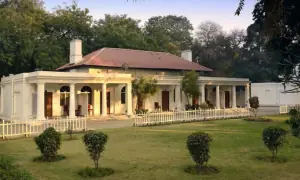
Health experts believe that an efficient primary healthcare system must provide services for 24-THE Mubarak Village dispensary which has been lying closed for years.—Fahim Siddiqi/ White Star
hour emergency, obstetric care, first aid, immunisation, maternal and infant care, school health service and family planning.
Painting a grim picture of the nation's health, the Pakistan Medical Association annual report 2007 states that the overall health situation has not changed in Pakistan for the past many years, though government funds for the health sector have been increased.
“An army of nurses and paramedics are required to run the 10,000 primary healthcare centres and 800 hospitals in the country with a population of 160 million. No government has ever made a comprehensive health policy to produce these professionals and provide a respectable career structure for them.
“The government initiative to produce community midwives in the absence of trained tutors would not produce competent health workers. It would be another waste of resources like the dai training programme in the past,” it says
Dr Shershah says that the lion's share of the meagre health budget goes to tertiary care hospitals meant for specialised treatment and 15 per cent is spent on primary healthcare which is set up to attend to 90 per cent of the patients. This reflects the government's misplaced priorities, he adds.
In the absence of an efficient primary healthcare system, it is not surprising to see that a large number of patients daily reporting at the city's tertiary care hospitals.
“At the Civil Hospital Karachi, around 18,000 women reported for gynaecological/obstetric emergencies this year. Of them, only 8,000 were admitted. That means that the emergencies of 10,000 women could be treated at primary healthcare centres if they were adequately equipped with facilities and manpower,” says Dr Farah Abdul Bari, managing the CHK gynaecology/obstetric department.
Explaining these 'mild' emergencies, Dr Bari said that women reported with different problems, including severe vomiting, diarrhoea and false labour pains.
“Those with false labour pains simply refuse to go home, saying that they are too poor and could not afford to go home and return at the time of delivery,” she said.
“As is the case with other public sector hospitals, the CHK faces an acute shortage of staff and resources and the employees work under stressful conditions. If primary healthcare facilities were properly equipped, it would definitely reduce burden on tertiary care facilities and improve the working of their staff,” she adds.