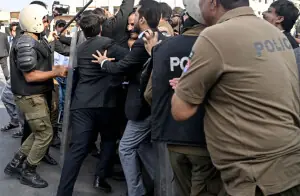
HOW can the executors of law and order be trusted when they themselves are violating the law? This is the sentiment the Islamabad police have provoked ever since it surfaced that members of the capital`s police force were illegally occupying public and private properties. As was revealed recently in the Senate, the Islamabad police are the top unauthorised occupiers of government accommodation in the capital city, its employees being in possession of 167 of the total of 337 government flats known to be illegally occupied. Retired officials from the Intelligence Bureau and the Federal Investigation Agency are also included in the list of 377 illegal occupants. Earlier, a report had exposed the unauthorised acquisition by the Islamabad police of an unoccupied private house owned by a former bureau chief of Dawn who passed away many years ago, and its conversion into an office for a superintendent of the police. The police may justify this action under Section 17 of the Land Acquisition Act of 1894 under which the government can acquire a piece of property anywhere in the country in “public and national interest”. However, the 1973 Constitution protects citizens` basic rights in this respect by not allowing government acquisition of any piece of land at will, especially when there are legitimate heirs.
One can understand the tremendous pressures on office space and the living quarters faced by federal government employees, including members of the Islamabad police force. This is evident by the fact that a total of 12,868 applications were received against the availability of 672 flats in a housing scheme for federal government employees in Grade 1 to 16. But this is no justification for unauthorised occupation. It is obvious that the basic requirements of government employees need to be quickly addressed and a solution found to the urgent problem of shortage of government housing and office space, particularly for employees in important organisations such as the police. But it is also necessary to ensure that `police power` is not wielded to get what one is apparently not entitled to, not eligible for and not authorised to take hold of.