0
0

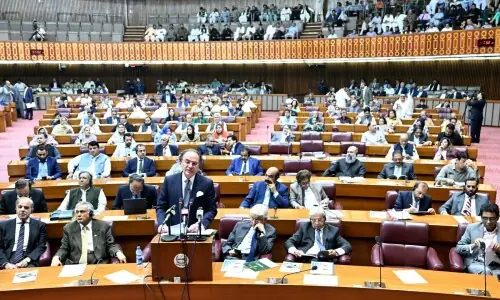
MUZAFFARABAD, June 17: The AJK’s record deficit but tax-free budget for the fiscal year 2002-2003, with a total outlay of Rs1,2073.5 million, was presented in the AJK legislative assembly here on Monday.
The budget allocates Rs8,773.5 million for non-developmental expenditures, which is 1.63 per cent more than the revised budget of the ongoing fiscal year, while Rs3,300 million, including a foreign aid of Rs412.6 million, have been proposed for the developmental activities.
AJK’s Finance Minister Shah Ghulam Qadir presented the budget in the House, which was presided over by Speaker Sardar Siab Khalid.
The budget envisages an income of Rs2,700 million to be generated from the internal resources of the state, including local taxes of Rs1,650 million from the AJK Council and Rs2,386.7 million from the federal taxes as AJK’s share. The gap between the income and the expenditures to the tune of Rs2,306.8 million would be bridged, as usual, by the government of Pakistan.
Regarding the increase in deficit, the finance minister said it was due to enforcement of the new pay scales for employees in grade 1 to 22 from Dec 1, 2001, in accordance with the decision of the federal government. As a result, he said, the AJK had to bear an additional burden of Rs328 million, which was provided by Islamabad.
He said the government of Pakistan had also increased the salary and emoluments of the president, governors and ministers, but the same for the members of the national and provincial assemblies was expected to be announced following the general elections in Pakistan.
The AJK government will also increase the salaries, perks and privileges of the president, prime minister, ministers, speaker, deputy speaker and leader of the opposition from next financial year and funds had been provided in the budget for the purpose. Apart from this, he said, the privileges announced by the federal finance minister in his budget speech of June 16 would also be accordingly provided in Azad Kashmir
The minister said the priorities as well as targets for the economic development of Azad Kashmir were to strengthen and properly utilize the indigenous resources of income. The territory of Azad Kashmir, he said, was rich in forests, hydel power, natural and mineral resources and the government’s foremost efforts will be to tap these resources to increase the income of the state as well as job opportunities.
Pointing out that the development activities in Azad Kashmir depended on the aid from the government of Pakistan, the minister said Islamabad would provide Rs3,300 million for the same during the next fiscal year, which was 34 per cent more than that of the revised developmental budget of the ongoing year (that is Rs2466.6m). Spelling out sector-wise allocations from the development budget, he told the house that the communications sector will receive the maximum share, that is Rs827.4 million. The initial allocation for this sector in the ongoing year was Rs486 million, which was later enhanced to Rs663.3 million in the revised budget of the current fiscal.
Other allocations proposed for the next fiscal year included Rs531.3 million for rural development programme; Rs458 million for education sector; Rs300 million for power sector; Rs290.2 million for physical planning and housing; Rs270 million for health services; Rs140 million for hydro power generation; Rs130 million for information technology; Rs115.9 million for resource management projects; Rs102 million for forests; Rs42 million for industries and the government printing press; Rs18 million for tourism, wildlife and fisheries; Rs17 million for water and irrigation; Rs10 million for planning and development; Rs10 million for agriculture; Rs10 million for animal husbandry; Rs10 million for Azad Kashmir Mineral and Industrial Development Corporation; Rs8 million for Azad Kashmir Small Industries; Rs5 million for social welfare department; and Rs5 million for environment protection.
Apart from this, the minister said, the World Bank and other financial institutions were providing resources for development projects, such as Northern Education Project and Neelum Jhelum Valleys Community Development Project. He said a high-level mission of IFAD (International Fund for Agriculture Development) had recently visited Azad Kashmir and committed with the prime minister that the fund would provide from next year more than Rs1.5 billion under a new five-year development project.
In the communications sector, the minister said, the inter-district roads and those connecting the AJK with Pakistan would be constructed as dual carriageway. While construction work on a number of other roads would be completed during the next year.
In the physical planning and housing sector, he said, public health engineering had been given priority, as it would get 74 per cent of the total allocation for this sector. The remaining 26 per cent would be utilized on residential facilities for the government employees during the next year.
Referring to the power sector, the minister said Wapda was upgrading three grid stations and planning to construct five more in different areas of Azad Kashmir to overcome the problems of power fluctuation, load-shedding and line losses. The line losses in the current year had been reduced from 41 to 39 per cent and in next year would be further scaled down to 36 per cent, he said.
The government had also decided to establish transformer-repairing workshops at district headquarters at a cost of Rs60 million. Of the 2,300 transformers requiring replacement 1200 would be changed next year at a cost of Rs200 million, he said, adding computerised billing system will also be introduced in the AJK to remove the complaints of inflated power bills at a cost of Rs60 million.
In the hydel power sector, the minister said, Rs68 million would be spent on the feasibility study of six projects, whose estimated potential was 1,082MW. The government had also decided to initiate work on a 60-MW hydel power project in Gulpur (Kotli) by involving private sector. The MoUs of the two projects, with an estimated generation capacity of 211MW, had been signed by the private sector and work on them would start in Jan, 2003.