0
0

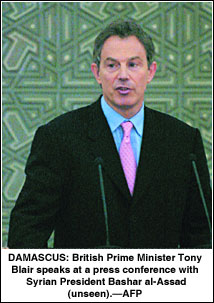 DAMASCUS, Oct 31: Syrian President Bashar al-Assad and British Prime Minister Tony Blair differed sharply on Wednesday on the meaning of terrorism, during a visit by Blair to Damascus.
While Assad said “there were several points of agreement” between them on the questions of terrorism and the Middle East peace process, he was inflexible over Syria’s support for anti- Israeli groups.
Syria saw things “with both eyes,” he told a joint press conference, adding that while there was international terrorism there was also “Israeli terrorism” against the Palestinians.
Assad also implicitly criticized Washington’s leading role and its strategy in the “war on terrorism” it declared in the wake of the September 11 attacks on the United States.
“The war against terror necessitates international action,” Assad said, while repeating Syria’s condemnation of last month’s attacks. “It is not up to one party to lead this action. On the question of terrorism, we have made distinctions between terrorism and resistance, and insisted on the distinction between Islam and terrorism,” Assad said.
“The war against terrorism must be settled first by a group definition of this phenomenon, by international cooperation, by solving the problem at its roots,” he said.
British officials had hoped that Assad would be more flexible on the question of backing for Palestinian groups and the Lebanese Hezbollah in his talks with Blair, the first British premier to visit Syria.
But the Syrian leader stood firm, comparing the fight against Israeli occupation with the French resistance to the Germans during World War Two under General Charles de Gaulle.
“We support resistance fighters who seek to liberate their lands,” he said. “Active resistance is very different from active terrorism.”
On the US strikes on Afghanistan, Assad said “we cannot accept the killing of hundreds of innocent civilians every day.”
Blair, for his part, said the US-led forces were doing their best to minimize civilian casualties.
He said the international community must throw all its weight into the fight against terrorism. The priority was to end terrorism and establish peace in the Middle East.
Blair repeated his backing for a Palestinian state alongside Israel, but said Syria and other major regional powers should use their influence to restrain Palestinian groups and work to ensure a period of calm.
“The only possible long-term solution is Israelis and Palestinians living side by side,” he said. “Whatever the differences are, the only way of restarting the peace process is by going back to the negotiating table.”
He also called for Syria and Israel to resume their peace talks, which broke down last year over the restitution of the Israeli-held Golan Heights. —AFP