0
0

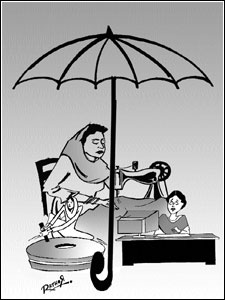 In order to bring about a positive change in socio - economic status of rural women who comprise almost 70 per cent of the total female population of Pakistan, a multi-pronged developmental programme is need to be undertaken.
Apart from laying emphasis on creating economic opportunities for women, it is essential to make available to them proper housing environment to ensure not only sustainability of their efforts towards attaining economic empowerment, but also to give them a social dignity and a livable environment.
The majority of rural population live in kutcha houses/huts with leaking roofs, poor ventilation and drainage and above all without a provision for cooking place and latrine. In majority of the villages, of all the four provinces, inaccessibility to drinking water is the common feature.
The poor rural women, particularly in Sindh and Punjab, who are mostly self-employed by undertaking farming and non-farming businesses, what they long for is a pucca house with proper drainage and access to potable water and electricity. The provision of space for their home-based business needs is must, specially, to facilitate storage of their raw material and finished products.
Poor women’s desire to improve their housing environment is impeded by their inaccessibility to institutional credit. Private moneylenders charge exorbitant rate of interest, thus their initiative to improve their abodes from where they operate their businesses also is suppressed. They need easy institutional credit without collaterals except which they can afford to offer. Besides credit, they need support services offering technical and legal information relating to housing finance.
Dr. Muhammed Yunus, founder of the Grameen Bank of Bangladesh, realizing the fact that unless the living environment of rural poor are improved on immediate basis, all efforts to salvage them from the clutches of poverty would be in vain. Thus the component of housing finance was added to the bank’s over-all programme of micro credit. Dr. Younus wanted to make investment in housing productive both for borrower and the bank itself and he succeeded. By year 2002, the bank had disbursed more than 7,000 housing loans with a recovery rate of 95 per cent.
The Sewa Cooperative Bank in India which is a totally women-owned and managed organisation has a similar success story. In India, half of the self-employed work force is represented by women. These self- employed women are characterized by insecure employment, lack of accessibility to institutional credit, lack of assets and trapped in extreme poverty. The bank was basically set up to disburse productive loans for micro businesses of poor women.
Later on they started offering housing loans to their clients in consonance with the charter of the bank, which says ‘main objective is to help poor women reverse the process of decapitalization at micro level and to begin the process of capitalization’.
The impact of housing loans disbursed by the Sewa Bank is depicted from the statement of Ms. Jayshree, managing director of the bank in the annual report. She says: ‘every small effort made to provide housing finance to the poor women has shown that even a very small input makes much of the difference in the life of the poor. Investment in housing for the poor is productive. They are bankable and ready to contribute to improve their housing condition. This is true especially for women as it gives them a sense of security and ownership’.
In Pakistan, unfortunately no initiative had been taken to provide shelter/housing to the poor until the year 1992 when funding agencies like the World Bank in collaboration with the Swiss Agency for Development and Cooperation (SDC) came up for promoting the idea of financing ‘housing for poor’ in Pakistan through public sector banks. Initially they had wanted to launch a pilot project for financing improvement in existing abodes of rural poor of interior Sindh. Big public sector banks being averse to the idea of micro-financing at that time declined the offer of their collaboration in the project. The First Women Bank (FWB) however agreed to undertake the project with the condition that housing improvement loans will be allowed only to:
a) families headed by women;
b) Women holding title to the property in their own names;
c) women along with their husband/father jointly, if male member gives undertaking that title to the said property would be transferred in the name of his women partner during the tenancy of the loan.
Despite a few thousands dollars financial support provided by aforementioned sponsor agency only for developing infrastructure for undertaking financing in rural Sindh, the bank disbursed around 650 housing improvement loans as envisaged in the programme, from its own resources.Women and their families living in kutcha one-room hut were able to have two pucca rooms along with kitchenette and latrine through these loans.
Hence this not only improved their living environments but also provided them enough space for handling their business affairs including storage of their raw material and finished products. The bank inducted few NGOs as facilitators in the programme for identifying potential borrowers, their group formation and above all for recovery of the loans. The scheme was found viable in view of high recovery rate and not much additional transaction cost as the loans were allowed only to the women who were already availing micro business loans from the bank.
The bank later on, in view of unlimited market for this product widened the eligibility criteria for housing loans; thus all self-employed women were rendered eligible for availing the housing improvement loan. These loans are offered at market rate and are secured against communal/group guarantee and ‘sanads’ of plots issued under the Gothabad Scheme covering certain parts of rural Sindh and suburbs of Karachi.
Despite viability of the programme only two big banks entered this area of micro-finance in late nineties but soon abandoned their schemes. The factors responsible for impeding fast expansion of the programme are:
a) the idea of performance-based financing for poor is not generally recognized by conventional banks. Banks however need to develop their confidence and trust in poor.
b) borrowers incapability to offer valid title deeds of the land they own (as is the case with the Gothabad Scheme in Sindh). In this regard, public land allotted to poor whether in urban or rural areas must transfer valid title to allottees. There should not be any restriction regarding sale and purchase of the property. This would remove reluctance on the part of banks to go for financing housing needs of poor.
c) Lethargic attitudes of the NGOs inducted for the programme as facilitators. This can be avoided if credible NGOs are inducted as intermediaries for disbursing loans in the areas that they are serving by extending a credit line to them against their assets or based on their track record.
Further, It is necessary that housing finance programme for the poor (whether male or female) should be characterized as productive loan, as majority of the borrowers from this segment of population are either self-employed or home-based workers. The provision of proper housing improves their efficiency and quality of products they produce, hence they can fetch better price.
A proper housing facility enables the owner to cut the waste relating to her/his business and enhance production by making use of new technology or in other words they can make use of equipment and machinery, ensuring economies of scale and marketability of the products.
No doubt borrowers inability to provide collateral discourages institutional credit to flow towards rural poor housing needs, yet this short coming can be covered by making it mandatory for potential borrowers to gradually build up their savings to a certain percentage of loan to be applied for in future. This will not only secure the loan to some extent, but would also prompt the clients to put in their best efforts to generate funds out of their business for developing their propensity and capacity to save.
In the present scenario when banks have ample liquidity, and are exploring consumer financing market the needs of rural women must not be ignored. Disbursement of micro housing loans of small amounts, not exceeding Rs40,000 per family by commercial and micro-finance banks operating in the country, strictly to improve their existing abodes, would also help achieving financing banks’ socio-economic welfare objectives.
The writer’s experience at FWB regarding micro-finance scheme for improvement of housing in rural Sindh has proved that these loans can easily be disbursed at market rate and recovered in five to seven years time. Hence there should not be any doubt regarding sustainability of the programme both for borrower and the financing bank.
In order to ensure that loan amount is properly utilized and adds to the value of the existing house, financing bank must look into the possibility of providing low cost housing development techniques in collaboration/linkage with governmental and non-governmental housing agencies. The National Building Research Institute, Karachi, has developed a number of modules of low cost houses by applying environment-friendly technology leading to the use of cheap and durable building material, suited to varying climatic conditions.
In order to enhance outreach and to facilitate operation of housing finance programme for rural women, financing banks should involve credible NGOs in the programme, who are doing community development work in rural areas. These NGOs can be helpful in imparting knowledge regarding loan obtaining procedures and legal intricacies involved to the potential borrowers, besides facilitating recovery of loans.
Further, financing banks must insist on involvement of women in planning and construction phase just to ensure provision of gender sensitiveness in the programme.
The FWB’s housing improvement financing programme, though restricted to few districts of rural Sindh and suburbs of Karachi, has impacted women making them socially and economically strong. The programme has created assets ownership for borrowing women and also helped their micro businesses to take off. Thus sizable number of women are able to repay the loans ahead of scheduled time.
Recent relaxation given by the State Bank of Pakistan to widen the scope of mobile banking for micro-finance banks, is enough impetus for them to launch housing finance programme for the rural poor, enabling them to attain livable housing environment and social dignity.