0
0

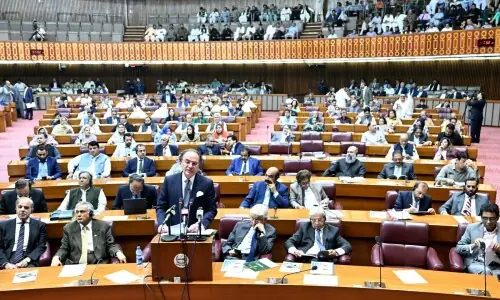
ISLAMABAD, Feb 20: There were both bouquets and brickbats for President Pervez Musharraf as the Senate on Friday began a debate on the address he made to a joint sitting of parliament more than a month ago amid noisy opposition protests.
As expected, opposition senators used the discussion - that will continue until Feb 29 - to criticize the president for his sweeping powers and formulating policies even after the establishment of a civilian government.
Ruling coalition senators defended the president mainly on the grounds of an economic recovery achieved after he seized power and for his declared policy to fight terrorism and religious extremism.
Senators also raised their voice about the fists the president had raised at the end his speech - opposition members calling the gesture a threat to political opponents and the ruling coalition seeing it as a sign of determination and a wish for national unity.
While leading senators of the People's Party Parliamentarians were in London for a meeting called by Benazir Bhutto, Prof Khurshid Ahmed of the Muttahida Majlis-i-Amal opened the debate with a well-prepared criticism of the man his alliance helped attain parliamentary legitimacy less than two months ago.
He accused the president of involving military in politics and making Pakistan subservient to US policies to the extent of compromising the country's nuclear deterrent and the Kashmir cause.
However, he acknowledged achievements in the economic field such as the highest-ever foreign exchange reserves and a decrease in fiscal deficit and inflation, but pointed to an increase in poverty and unemployment that he said forced many people to commit suicide.
Prof Khurshid suggested a nine-point remedial plan, including calls for a restoration of the "true principles" of the Constitution within this year, revival of judiciary's prestige, a "re-examination" of foreign policy to make Pakistan independent of American policies, formulation of bipartisan national policies to defend the country's nuclear assets and its stand on Kashmir, and a "national reconciliation" that should also involve political leaders living in exile.
The plan also called for an agenda and legislative programme for parliament for the whole year, putting local bodies under provincial control rather than being an "offshoot of the presidency", across-the-board accountability by an independent organization rather than the National Accountability Bureau that "has lost it credibility", reform of the presently "lop-sided" education policy, and better healthcare.
Prof Khurshid said he had thought Gen Musharraf would become a statesman after the 17th amendment, but "he is taking the role of a commando in parliament and politics rather than in battlefield".
He urged the government to give up the idea of reviving the National Security Council (NSC), although the MMA had agreed with the government in their deal over the LFO to create the NSC through an act of parliament rather than having it as a constitutional body.
Shazad Waseem, a PML-Q back-bencher from Punjab who was the first speaker from the ruling coalition, questioned MMA's moral right to oppose the president after joining hands with the government in the parliamentary approval of the Legal Framework Order.
"It was not a commando's clenched fist but a gesture of his determination to take along everybody," he said of the president's gesture. Sanaullah Baloch, parliamentary leader of the Balochistan National Party (BNP-Mengal), delivered a blistering attack against Gen Musharraf, whom he would not recognise as president for not being elected as provided under the Constitution.
He accused Gen Musharraf of failing to fulfil any of the seven promises he made after seizing power in October 1999, taking the country to a decline and a unitary form rather than a federation envisioned by the Constitution, and said the situation called for a "new constitutional agreement" to meet complaints of deprived provinces.
Mr Baloch, whose comments provoked protests from some ruling coalition members, said the proposed NSC would be a club of elites responsible for former East Pakistan's secession in 1971 and provincial deprivations and would plunge the country into more crises rather than ridding it of existing ones.
Mohammad Abbas Komaili of the Muttahida Qaumi Movement (MQM) said the president had fulfilled all promises made by him, including restoration of democracy, and launched the "real jihad" against corruption, terrorism and extremism. But he warned the president against the "dangerous disease" of regarding himself as an "Amirul Momineen" deserving unconditional obedience as advised by some ulema.
Dr Akbar Khawaja of the PPP called the president's speech a mere eyewash, seeking to entrench himself and called for an apology from him for showing fists to parliamentarians.
PPP's Mohammad Latif Khosa, also from Punjab, called Gen Musharraf's address an insult to parliament, and said he would move a resolution in the house to reject it and call for him to relinquish power to pave the way for a civilian rule and restoration of parliamentary democracy.
This appeared to be a move to counter the government motion before the Senate seeking to express "deep gratitude to the president for his address". Former information minister Nisar Memon (PML-Q, Sindh) described the president as a "bridge between Islam and the West" and defended what he called a proactive foreign policy of the government and Pakistan's support for the US-led military action in Afghanistan, which he said was in national interest.
Without naming former prime ministers Benazir Bhutto and Nawaz Sharif, he said it was not necessary to bring political leaders living abroad while local leadership could represent their parties.
Others who spoke were Tahira Latif (PML-Q, Islamabad), Mrs Tanvir Khalid (PML-Q, Sindh) and Syed Hidayatullah Shah (MMA, NWFP) before the house was adjourned until 5pm on Monday because of lack of quorum that interrupted proceedings twice during the evening sitting.