0
0

ISLAMABAD, Nov 22: Pakistan has reiterated its stand that allowing officials of the International Atomic Energy Agency (IAEA) or scientists of any American think tank to question or talk to Dr A.Q. Khan, held in protective custody of Pakistani security agencies, is out of question.
Recently, an American scientists' think tank had demanded interview with him on the plea that they would like nuclear security experts of foreign agencies to discover the full extent of the illegal spread of nuclear technology and material because it nursed fears that these might have been sold to extremists and terrorists of different persuasions.
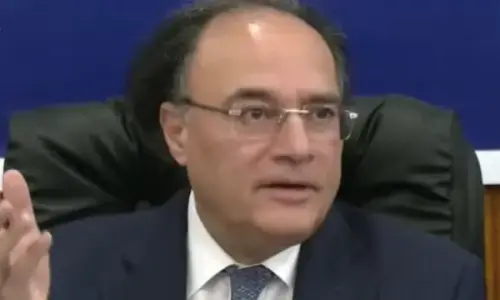
Foreign Office Spokesman Masood Khan told newsmen at his weekly briefing on Monday that the government was confident it had its own security and interrogation system which was adequate and functional.
"It would not be possible to offer direct personal access to Dr Khan," he said, but was quick to reassure that the Pakistan government had been cooperating with the IAEA and the international community - something that remained uninterrupted.
Referring to Prime Minister Shaukat Aziz's New Delhi visit, starting from Tuesday, the FO spokesman said his talks with Indian Prime Minister Manmohan Singh would take place "at an important juncture in India-Pakistan relations".
In the backdrop of a pledge made by Mr Singh in his first meeting with President Pervez Musharraf in New York on Sept 24, the spokesman reaffirmed Pakistan's wish to resolve all its differences with India, including the issue of Jammu and Kashmir, through peaceful means.
The president had also initiated a domestic debate on various options he had outlined during an Iftar dinner for the resolution of Kashmir issue. It is against this background that Prime Minister Aziz will be meeting his Indian counterpart, the spokesman added.
"Pakistan will continue to engage in the twin process of confidence-building and dialogue which we hope will result in resolution of all outstanding issues, specially the Jammu and Kashmir dispute, and pave way for peace, stability and cooperation in South Asia," he said.
When asked to comment on Mr Singh's public statements during his first visit to the Indian occupied Kashmir reiterating New Delhi's claim over Jammu and Kashmir, the FO spokesman said Pakistan had emphasized that the spirit of Sept 23 joint Indo-Pakistan statement in New York should not be scuttled.
He recalled that subsequent to his Srinagar visit, Mr Singh also maintained that India was "serious about the composite dialogue and its continuation". Replying to another question, he said that in the ensuing second round of bilateral talks, experts of the two governments would meet soon to discuss nuclear and conventional weapons CBMs, including asymmetry between India and Pakistan in conventional weaponry in a strategic sense and which needed to be rectified.
He rejected India's protest to the US administration over its decision to provide $300 million worth of military assistance to Pakistan and Afghanistan, saying that India's protest was unjustified since in contrast to this limited assistance, India in its ambitious military weaponry programme had been acquiring weapons from all over the world, including Russia, Europe, the USA, and Israel.
In his talks with his Brazilian counterpart, when he sets out later this week on visits to three Latin American countries, President Pervez Musharraf would discuss the proposed UN reforms which, among other things, seek to increase the strength of the Security Council from the existing five members, the FO spokesman told a questioner.
The president would tell his interlocutors that Pakistan would desire greater democratization of the UN system and the Security Council by general consensus of the entire UN membership, giving grater representation to the developing countries, Mr Khan said.
Pakistan was opposed to creation of more permanent "centres of privilege and power" as permanent members of the Security Council and sought comprehensive reforms in the UN system, he said. Brazil is seeking one of the proposed five more permanent members seats of the enlarged Security Council.