0
0

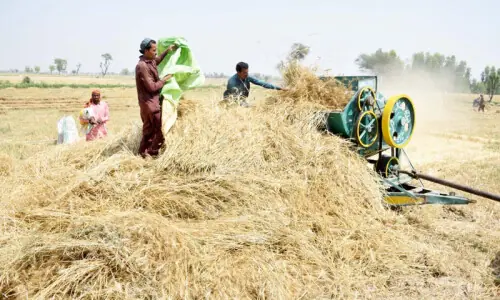
Agriculture, as is known contributes 25 per cent to our GDP, provides employment to about 47 per cent of the workforce, and contributes, directly or indirectly, 65 per cent to export earnings.
Therefore, it is imperative to take into account the problems or challenges likely to be encountered after the World Trade Organization regime becomes effective, i.e., after December 31, 2004.
A review of the WTO Agreement on the Application of Sanitary and Phytosanitary Measures (SPS Agreement) in the light of various provisions of the existing Plant Quarantine Rules 1976 of the Department of Plant Protection, which is working under the federal ministry of food, agriculture and livestock (Minfal), indicates that under the WTO regime our agriculture sector will become vulnerable to a variety of exotic (alien) species injurious to field crops, horticulture, floriculture and forest, besides many other problems especially related to farm export.
To prevent the introduction and spread of exotic pests and diseases Destructive Insects and Pests Act 1914 was revised from time to time and finally in 1976 renamed as the 'Pakistan Plant Quarantine Rules-1976 cannot safeguard the agricultural wealth of the country from the invasion of alien pests and diseases.
Effectiveness of the existing plant quarantine regulatory service could be gauged from the fact that in 1989 an exotic virus disease appeared on banana plantation in a small pocket at Ghorabari in district Thatta.
Later on the very disease was identified as the Bunchy Top Virus Disease (BTVD). In spite of the fact that the BTVD was an exotic disease no action was taken either to eradicate or contain its spread in other banana growing areas.
Now the situation is that after bringing devastation in lower Sindh the same disease is devastating banana plantation in the upper Sindh, also. The extent of economic loss following the introduction of exotic BTVD to the province of Sindh could be calculated on the basis of the fact that in District Khairpur alone demise of banana plantation on about 50,000 acres has caused loss of over Rs2.5 billion.
The plight of growers is beyond comprehension. Many suffered heart attacks and many became bankrupt. The fruit bearing stage banana crop use to fetch Rs50,000 to Rs120,000 per acre per annum.
The spread of bunchy top virus disease could have been contained by providing virus free banana suckers developed through the tissue culture. But Parc, which maintains a huge tissue culture laboratory in Islamabad, remained a silent spectator.
They did not bother to establish even a small tissue culture laboratory in Thatta using its Sugarcane Research Building. Besides, the BTVD other pests and weeds have also entered into Pakistan because of the perforated quarantine regulatory services.
The most haunting aspect is after the implementation of the WTO regime when there would be tremendous increase in trade and travel among member countries which will enhance the chances of introduction and spread of alien pests and diseases.
Species invasion is the darker side of international trade and travel - a global ecological time bomb whose explosive potential is just starting to get full attention. Indeed, the whole process of economic globalization is just one aspect as biological globalization is transforming ecosystem as well as societies everywhere.
In Pakistan no efforts have been made to estimate the loss. However, by one estimate exotic pests cost the US agriculture, forestry, and construction about $80 billion a year, more than the value of the US agricultural exports.
The ecological effects are even more alarming through competition, predation. Infection- invasive species are now widely considered as the second most important cause, after habitat loss, of extinction and loss of biodiversity.
SUGGESTIONS: Under the SPS Agreement no member country should be prevented from adopting or even enforcing measures necessary to protect human, animal or plant life or health.
It is imperative that the existing Plant Quarantine Rules 1976 are updated and thoroughly revised in the light of laws and rules prescribed in the WTO. Besides, to keep a watch on alien species invasion and its spread, region-wise crop pests surveillance be made a regular feature of plant quarantine regulatory service by the Federal Plant Protection Department, which is responsible for maintaining the international plant quarantine services in the country.
Besides, for detection and identification of the alien pests and diseases advance screening methods be introduced in the plant quarantine laboratory of the DPP, which is almost non-existent.