0
0

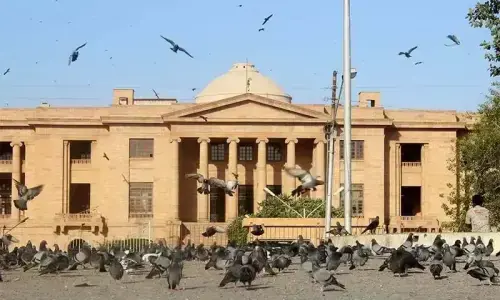
KARACHI, July 13: The Sindh High Court dismissed on Tuesday an appeal moved by the Karachi Electricity Supply Corporation against an order for payment of Rs840,000 in damages to the father of a man electrocuted in 1988 by a live wire lying on the road.
The plaintiff, Syed Iqbal Hussain Jafri, had moved the high court on the original side through Advocate Nasir Maqsood under the Fatal Accidents Act. He had sought damages amounting to Rs1.2 million from the KESC for the death of his son, Syed Aley Husain.
Decreeing in 1993 to the extent of Rs840,000, Justice G. H. Malik (since retired) held that the plaintiff had proved that his son died as a result of electrocution by an electric wire that had broken loose and was lying on the road unguarded and unattended.
The circumstances pointed prima facie to KESC's failure to take care. The corporation failed to show that it had taken all reasonable precautions to prevent the overhead wire from breaking loose and to avoid injury to the deceased. Heavy rain on the day of occurrence could not be pressed as a pretext for the accident.
The KESC challenged the judgment and decree in appeal but a division bench, comprising Justices Sabihuddin Ahmed and Mohammad Afzal Soomro, upheld both. It observed that despite heavy rains, the duty to maintain overhead wires properly was not performed by the corporation.
As for the quantum of damages, the appellate bench referred to a 1992 Supreme Court judgment in the case of KRTC versus Latifur Rehman. The judgment declared that an appellate court would not interfere with the amount of damages awarded by a trial court unless it could be shown that the latter applied a wrong principle of law in assessing damages or the damages were assessed unreasonably.
Neither of the two conditions appeared to exist in the present case, the SHC appellate bench observed.
Father allowed to meet children
KARACHI, July 13: The Sindh High Court on Tuesday allowed a Pakistani working in Kuwait to meet his son and daughter in a local hotel once a month on Saturday.
Disposing of a writ petition moved Abdur Rahman Sheikh for custody of his children through Advocate Munawwar Sultana, Justice Sabihuddin Ahmed left the issue of permanent custody to be decided by the family court already seized of the matter.
The petitioner has sought transfer of the case from the court of a senior civil judge (district east). Rahman and Atiya Iqbal were married in 1995 and have a seven- year-old son and five-year-old daughter. Their relations soured and they separated in February.
The children were brought to Karachi by Atiya after their separation. The court ordered that the children would be allowed to stay with their father in a Karachi hotel for the whole day once every month on a mutually-agreed Saturday.