0
0

NEW DELHI, June 7: Indian President Abdul Kalam said on Monday that New Delhi would give highest priority to improving all-round ties with its neighbours, including Pakistan.
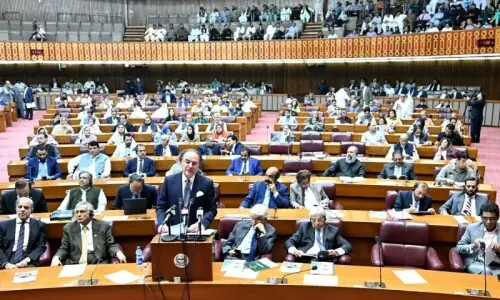
In a traditional address to a joint sitting of the parliament's two houses to inaugurate Prime Minister Manmohan Singh's coalition government, Mr Kalam clarified that peace talks with Pakistan would be held within the framework of the 1972 Simla Agreement and all subsequent pacts agreed by the Vajpayee administration.
There has been some kite-flying in the media on both sides of the border about what the Indian government intended to do with the agreements signed by former prime minister Atal Behari Vajpayee with his Pakistani interlocutors.
Indian Foreign Minister Natwar Singh has been insisting that he was misquoted when newspapers said he would stick to the Simla Agreement to the exclusion of other agreements.
President Kalam said the boundary question with China would be pursued "purposively" and while it attaches highest importance to ties with the United States, India would seek closer strategic and economic engagement with Washington, the European Union and Japan.
Reading out what is essentially a policy statement drafted by the government of the day, the Indian president said: "My government will give the highest priority to building closer political, economic and other ties with its neighbours in South Asia and to strengthening the Saarc. Particular attention will be paid to regional projects relating to water resources, power and ecological conservation."
He said: "Dialogue with Pakistan on all outstanding issues will be pursued on a sustained basis within the framework of the Simla Agreement and all subsequent agreements between the two governments, including the Joint Statement of Jan 6, 2004."
In what must be a sensitive balancing act, given the heavy Tamil component in Dr Singh's government, Mr Kalam said India will support the peace initiative in Sri Lanka that fulfils the requirements of all sections of the people of Sri Lanka for a life full of dignity and self-respect and meets the legitimate aspirations of all linguistic and religious minorities, while respecting the territorial integrity and solidarity of Sri Lanka.
"My government shall seek to resolve outstanding issues with Bangladesh and strengthen our relations with this important neighbour. It will continue to attach great importance to our close and vibrant partnerships with Bhutan, Nepal and Maldives."
He said trade and investment with China will be expanded further. "Talks on the boundary question will be pursued purposively." Giving a possible hint about the new government's quest for a common nuclear stance involving Pakistan and China, Mr Kalam said: "India will also expand political and security exchanges with China to ensure regional security."
India welcomes moves for an early restoration of sovereignty to the people of Iraq and notes with satisfaction the UN involvement in this process, he said. "Our traditional friendship with Afghanistan has been revived under the Government of President Karzai.
My government has developed multi-faceted cooperation with Myanmar, Iran and all the countries of Central Asia." India, Mr Kalam said: "Attaches high importance to its relations with the United States of America. We will pursue a closer strategic and economic engagement with USA, the European Union and Japan."
He said the Russian Federation remains an important entity in India's foreign policy orientation, given the long-standing and multi-dimensional convergence of interest and the resultant strategic partnership between India and Russia.
"Our relations with Israel, which have developed on the basis of mutually beneficial cooperation, are important, but this in no way dilutes our principled support for the legitimate aspirations of the Palestinian people," Mr Kalam said.
He said the government will repeal the controversial anti-terrorism POTA law that targeted political rivals of the government of the day. There would be a new law to deter communal rabble rousing.