0
0

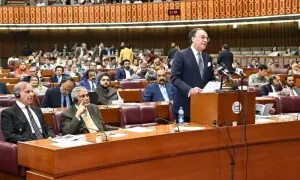
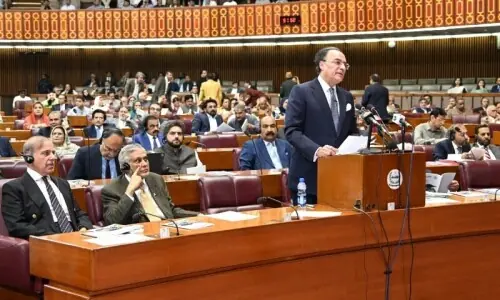
ISLAMABAD, March 24: The People's Party Parliamentarians (PPP) moved on Wednesday a bill in the National Assembly to provide for elimination of gender discrimination in the country , challenging the government to prove its moderation claims and opening a row with hardline Islamic parties.
The Protection and Empowerment of Women Bill, whose series of proposed measures include a repeal of Hudood ordinances enforced by the late military president Gen Mohammad Zia-ul-Haq, was immediately opposed by the government although prime minister's adviser on women development Neelofar Bakhtiar said she agreed with the spirit of the move.
The opposition to the bill moved by nine PPP women members for the formal introduction also came from the Muttahida Majlis-i-Amal (MMA) alliance of six Islamic parties, almost all of which support Islamic ordinances promulgated in 1979.
The private bill was formally moved by PPP member from Sindh Ms Sherry Rehman with eight other co-sponsors: Ms Ruqia Khanum Soomro, Dr Azra Fazal Pechuho, Ms Naheed Khan, Ms Nafeesa Munawar Raja, Dr Fahmida Mirza, Ms Shamshad Sattar Bachani, Ms Rukhsana Bangash and Ms Fauzia Habib.
Ms Bakhtiar's opposition to the bill "for the time being" was greeted with desk-thumping cheers from the MMA members. However, the adviser later told the house that "most purposes (of the bill) are very, very good", but said there were "some problems" regarding policies and legislation for which the move had to be considered by various ministries.
She said the present government was already implementing some provisions of the bill, and added: "We are in agreement with the philosophy and spirit of the bill."
MMA member Farid Piracha from Punjab rose just to record opposition to the bill by his alliance, whose members are likely to speak later in what could be a heated debate between PPP's legal minds and MMA's Islamic scholars.
The bill's sponsors particularly attacked Gen Zia's Hudood ordinances, under which, they said, many women had to suffer injustice on the allegations of Zina and evidence of two women has been equated with that of one man in legal proceedings.
Ms Sherry Rehman said what was the use of these ordinances when some of their provisions such as stoning to death for Zina and amputation of hand for theft had never been implemented.
Repeal of the Hudood ordinances has also been demanded by the government's Status of Women Commission whose recommendations are being examined by the government.
Other proposals in the bill include compulsory primary education for all children under 10 years of age, equal participation of women in all walks of life, equal pay for equal work, prohibition of violence against women and honour killings, freedom for every woman to marry a person of her choice, separate women wards in jails and at least one-third seats for women on the Council of Islamic Ideology, Planning Commission, Board of Directors of the Pakistan International Airlines, University Grants Commission and autonomous bodies.
Only four of the sponsors had spoken on the bill when the house was adjourned until 9.30am on Thursday. But the discussion on the bill's introduction will be resumed on the next private members' day on Tuesday.