0
0

WASHINGTON, Feb 26: Some key allies in the "war on terrorism" made glaring human rights violations last year, says an annual US State Department report sent to Congress on Thursday.
The report serves as a guiding document for legislators during foreign policy debates in the two houses, particularly when a request for financial or military assistance from a country comes up for hearing.
Saudi Arabia is criticized in the report for its continued refusal to allow its citizens to elect a government. Pakistan is reprimanded for "extra-judicial killings" and sectarian violence. Egypt is censured for retaining emergency laws that allow the government to jail, and even execute, citizens without proper judicial proceedings.
Secretary of State Colin Powell, who launched the report at a gathering at the State Department on Wednesday, pointed out that "even a cursory reading of the country reports for 2003 confirms that many - too many - governments across the globe still violate the most basic rights of their citizens".
Reports from Saudi Arabia also indicate that security forces continue to torture and abuse detainees and prisoners, arbitrarily arrest or detain persons, and hold them incommunicado.
"The government restricted freedom of assembly, association, religion and movement. Violence and discrimination against women, discrimination against ethnic and religious minorities, and strict limitations on workers' rights continued," the report said about Saudi Arabia.
There's a positive change in the attitude of Saudi officials, however, the report said. The government "also met with organized groups of reform advocates and permitted (the New York-based) Human Rights Watch to visit the kingdom for the first time".
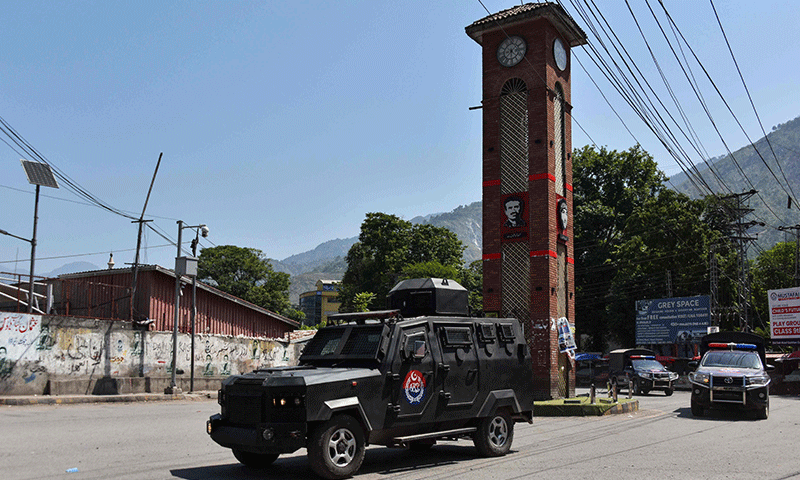
PAKISTAN: Even Pakistan was not spared. "In Pakistan, abuse by members of the security forces, ranging from extra-judicial killings to excessive use of force, is widespread. The government intimidated and arrested opposition figures. The overall credibility of the judiciary remained low."
Another ally, Egypt, gets a pat on the back for abolishing state security courts. But the report notes that the government retained and continued to use emergency courts, and most observers noted this was not a substantial improvement. Security forces continued to torture prisoners, arbitrarily arrest and detain persons, and occasionally engaged in mass arrests.
HARSHEST CRITICISM: While allies are censured for human rights violations, the harshest criticism is reserved for countries that have differences with the United States or are seen as defying US and Western influences.
China continued "harsh repression of the Falun Gong, and the Chinese government used the 'war on terror' to justify its continuing crackdown on Muslim Uighurs", the authors said.
North Korea is described as "one of the world's most inhumane regimes" in the report, where "basic freedoms are unheard of, and the regime committed widespread abuses of human rights".
Iran is mentioned as another state where human rights record worsened and the government continued to "commit numerous, serious abuses". About Cuba, where 75 protesters were sentenced to prison terms averaging 20 years, the report speaks of "dramatic" worsening of human rights abuses.
The government of Zimbabwe, the report said, continued to conduct a concerted campaign of violence, repression and intimidation. In Russia, "the conflict in Chechnya continued to have serious human rights implications. Reports of continued violence and human rights abuses in Chechnya persisted", the report said.
Many republics of the former Soviet Union are also criticized for their mixed or poor human rights records. Some Middle Eastern nations, particularly those allied with the United States, are praised for granting at least some rights to their citizens.
"In Qatar, voters approved a new constitution by popular referendum held in April. That same month, Yemen successfully held open parliamentary elections for the second time in its history.
In Oman, approximately 74 per cent of registered voters participated in October elections for the 83 seats in the consultative council. In Jordan, King Abdullah appointed a new 55-member Senate in November, increasing the number of women members from three to seven. In Morocco, 2002 voting for a parliament was followed up with 2003 elections for municipal councils."
Turkey passed "extensive human rights reform packages that covered a broadening of laws on torture, impunity, access to attorneys, fair trials and freedom of speech", although, the report added, not all of these reforms were fully implemented during the year.