0
0

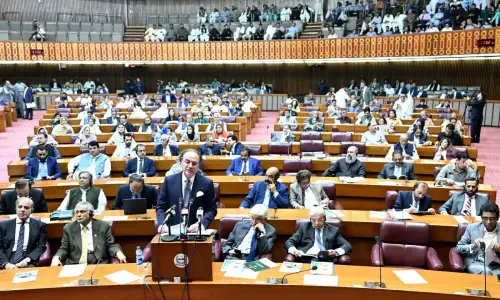
ISLAMABAD, Jan 12: Federal Minister for Environment Hameedullah Jan Afridi on Monday informed the National Assembly that 82 smoke-spewing brick kilns located in the proximity of the Benazir Bhutto International Airport will be shifted to a suitable place in a phased manner.
Mr Afridi told the house during the question hour that these brick kilns pose a danger to the flights as, depending on the wind direction, the smoke emitted by them affected visibility.
He said a committee constituted by the Islamabad Capital Territory (ICT) administration under the chairmanship of the district’s chief commissioner had worked out a phased plan to shift the brick kilns.
In the first phase, 12 brick kilns falling in the red zone very near to the airport will be relocated. In the second phase, 20 brick kilns located beyond the red zone but close to the airport will be shifted. Lastly, the rest of the brick kilns will be relocated.
According to the minister, a compensation plan worked out for the relocation of the brick kilns was currently being considered by the Ministry of Interior.
Giving details of other steps, he said two brick kilns adjacent to the airport were issued orders to stop operations, but one of these obtained a stay order from the court.
Mr Afridi said construction of a model brick kiln unit based on vertical shaft brick kiln (VSBK) technology was underway with the assistance of a Swiss organisation. Brick Kiln Association is keen to switch over to the new technology, once it is successfully demonstrated.
With the mercury coming down, air travellers at the Benazir Bhutto International Airport in Islamabad are facing delays because of the smog caused by the brick kilns in the vicinity of the airport.
Every year during peak winter season, almost all morning flights are affected by poor visibility resulting from the smog. Though the problem is recurrent, the civic agencies have taken no action to solve the problem and save air travellers from agonising delays.
Eighty commercial flights depart and arrive at the airport daily. “The smoke emanating from the kilns gets condensed in the air during the winter season due to low temperatures and reduces visibility of the pilots during landing.”
Black smoke in particular poses danger to small training aircraft like the Cessna planes. The flying club located adjacent to the airport has several small aircraft.
Experts said smoke from brick kilns after mixing with fog turned into smog, which was a thick layer of haze through which visibility was only 50 per cent.
The kilns in the airport’s vicinity pose more danger to small aircraft as most of them are without automated landing systems. The brick kilns within and around Islamabad, spew out high concentration of black soot, poly-aromatic hydrocarbons and other gases. The gases are not only deteriorating air quality of the area and degrading soil but also causing visibility problem and hazards to aircraft navigation.
An Environment Protection Agency official said there were around 200 kilns operating in the vicinity of the twin cities. Though these were initially located outside city limits, the mushroom growth of private housing societies in the last few years has brought them within the cities’ confines.
The official said the brick kilns use low-quality fuel, which was damaging the environment of the twin cities.
Emission of pollutants that cause health problems has been one of the major criticisms of the traditional clay-brick industry in the vicinity of the capital city. Now emissions from these brick kilns – in the form of visibility-reducing smog – have also been blamed for disrupting and putting at risk flights at Islamabad’s airport.
Despite several attempts in the recent past to ‘clean up’ the polluting brick kilns, the results have been discouraging.
Pressurised into taking remedial measures, the brick-makers’ association in the twin cities, in conjunction with the environmental authorities, has been trying to introduce new kiln technology that is not only less polluting but also more fuel-efficient.
However, nothing much success has been achieved from these moves, apart from the recent setting up of a ‘model’ brick kiln in the vicinity of Islamabad with the help of an international non-governmental organisation.
A similar pilot project introducing new kiln technology was also launched in the 1990s in Peshawar and other areas in the NWFP, but for a variety of reasons the new technology failed to make any significant breakthrough in the brick industry.
The traditional attitudes of the kiln owners’ fraternity and the lack of policy intervention by the government have been the key constraints. Limited technical and managerial capability of brick-makers and their ‘mechanisation phobia’ have been major hurdles in introducing new technology in the industry.
At the same time, there has been a lack of incentives to modernise the production process. The industry lacks access to institutional finance for investing in new but inexpensive technologies as well as technical support for adapting to new production methods.
Policy support at the official level is, therefore, crucial for ensuring wide acceptance of new and greener technology in the sector. This together with steps to regulate the brick industry by enforcing environmental laws, implementing existing laws against bonded and child labour, for which the industry has been widely criticised, and formulating new regulations to improve the appalling working conditions in kilns will help improve an important industry which for decades has been resistant to change.