0
0

 CHEAP and reliable energy is the driving force for any economy. Pakistan has a very limited fossil fuel resource base and the current state of the economy does not allow the import of fossil fuels, particularly oil, on a large scale.
But reliance on imported oil is critical for energy security. A large part of the population lives in remote areas and is waiting to be connected to the national electricity grid. To help these remote communities, and to overcome energy shortages in general, a strong political will is needed to develop its indigenous energy resources(hydro, solar and wind).
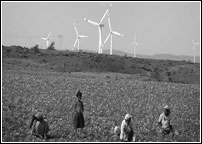
Pakistan is blessed with vast wind corridors from the coast of the Arabian Sea to the towering mountains of the Himalayas. More than 1000 km long coastline in south and northern mountainous areas provides an excellent resource for wind energy. This vast potential can be exploited commercially to produce electricity on community and wind farm scales.
Pakistan can ill afford to ignore the importance of alternate sources of energy and the role hydro power can play for it, if harnessed properly. Tidal energy, geo-thermal energy and wind energy are some of the new dimensions of electricity production.
Apparently aware of the situation, the Alternative Energy Development Board (AEDB) plans to produce 5,000MW of energy within five to seven years utilising the available renewable energy resources. The board is reported to have evolved medium-term and long-term poliies. The first 50MW wind power project is scheduled to be commissioned shortly and five turbines of 1.2MW capacity each have already been installed in the first phase of the project.
A Turkish company is close to completing the first windmill in Jhimpir, 70km from Karachi. Company’s CEO Osman Ipek is reported to have said: “The potential is immense, wind density and speed is sufficient” and added the natural wind corridor spans from Gharo to Keti Bandar in Sindh.
Project Manager Yagmar Ozdemir is quoted saying that the sale price of wind energy is competitive as the internal rate of return of 15 per cent (annually) is very good. Other countries do not offer more than 12 per cent.” On the lacklustre progress, an AEDB official said it involves technical issues like a delay in leasing out land by the Sindh government. An agreement on 33,000 acres of land has just been concluded, he added.
Pakistan is naturally blessed with a terrain that boasts some of the highest mountain ranges in the world and which also serve as the sources for all of its rivers. It possesses K2 which is the second highest point on earth with the water going all the way to sea level through a course of hundreds of miles. Water coming from such high sources serves as huge repositories of potential energy which can be harnessed not only to produce cheap energy but also for water conservation projects for agriculture.
Right now millions of cusecs of water are wasted in rivers and thrown out straight to the sea without much use. It is high time to construct small dams and water reservoirs for electricity production and agricultural purposes. Even rain water should be conserved in special reservoirs built for the monsoon season which can convert deserts and vast areas of Balochistan into green belt.
There is a need to go all out for these energy projects so that none of the industrial units or houses and businesses are ever out of energy.
Textile (earner of 60 per cent foreign exchange} and other industries always complain of power outages and high costs of energy. If we use hydro power and alternate sources of energy, the cost of utilities can be lowered and cheaper electricity can be provided to the consumers through better energy management.
Planners should also think about requiring vehicles to run on electric power by the year 2012. Many countries have taken the initiative of using electricity to power vehicles. In Nepal, many firms have mushroomed that offer vehicles run on electricity using multiples of car batteries. Britain has submarines that are powered by batteries.
If steps are taken right now for generating hydro-power along with alternate sources of energy, oil imports can be cut drastically by 2020.
Alternate sources of energy like wind and solar power are being exploited by many countries. China offers a full range of wind turbines, from home turbines of various production capacities to industrial wind turbines.
Pakistan can easily import and employ these turbines on mass levels to generate energy for homes. Some private parties can even sell excess electricity to the government as is done in the United States, lowering costs of production for the government. Most wind turbines only require sustained winds at low wind speeds which are suitable for many areas.
The country is also blessed with plenty of sunshine which can be harnessed to produce solar energy. Currently, it has a very limited application as such a natural gift is being utilised only to light a few parks. Endowed with a abundance of sunshine round the year, 1800 Kwh per square meter can be produced annually, that is cost effective compared to Europe’s average produce of 1000kWh a year. Wider use of solar panels can illuminate homes and street lights at much lower costs efficiently.
Installing a solar panel with each street light would not only reduce the burden of the government to produce energy but would also lower costs associated with wiring of street lights as lights with solar panels do not require an exorbitant amount of wiring due to the distance between the source (solar panel) and use (light) being small. The country’s main artery, motorway M-2 is fitted with solar panels that power emergency phones every few kilometers.
Given political will, the day is not far away when we would not only tide over the energy crunch but would be driving solar cars on highways lighted by solar energy and homes powered by alternate sources of energy like wind and solar power.
The sooner Pakistan realises the potential of wind, hydro and solar power along with electric powered vehicles, the better it would be for the country’s economic progress.