0
0

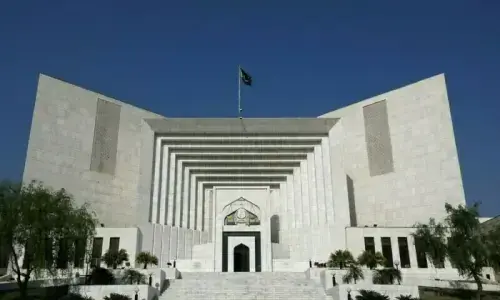
LAHORE, Dec 18: Attorney General of Pakistan Sardar Latif Khosa has said the federal government does not intend to withdraw its appeal from the Supreme Court against the disqualification of PML-N patron Nawaz Sharif.
He was replying to reporters’ queries after appearing before a division bench of the Lahore High Court.
Mr Khosa refused to answer a question on the controversy about additional marks to the daughter of Supreme Court Chief Justice Abdul Hameed Dogar, saying that he could not comment on the subject because he was to appear in the same case before the apex court on Friday (today).
The attorney-general said a judge could not be summoned by the assembly and added the National Assembly’s Standing Committee on Education had called Justice Dogar in the capacity of a student’s father.
To a question about restoration of deposed CJ Iftikhar Mohammad Chaudhry, the attorney-general said the Parliament had the power to decide the matter. “Mian Nawaz Sharif has also sought recommendations with regard to this matter from constitutional experts,” he said.
Asked why not the controversy about Justice Dogar be taken up by the Parliament when it could decide what to do with the deposed chief justice, Khosa said, “All matters shall be dealt with in accordance with the law and the Constitution.”
POWER TARIFF: The Lahore High Court on Thursday put off hearing of petitions against tariff increase by National Electric Power Regulatory Authority till Dec 22.
The court also extended the stay against the tariff in question.
Earlier Barrister Syed Ali Zafar extended arguments on behalf of All Pakistan Textile Mills Association (Aptma), Ashiana Cotton Products and other petitioners.
Mr Ali arguing for textile mills located in the jurisdiction of Faisalabad Electric Supply Company, said this was a unique case because Fesco never filed a petition for increase in tariff and yet Nepra on its own increased the rates only on the ground that this would be consistent with other distribution companies (Discos).
The counsel argued that the order of Nepra was illegal because even if Nepra could revise the tariff suo motu, it still had to follow the principal of natural justice and hearing and had to deal with the objections of all stakeholders and consumers of Fesco, which was not done in this case. In fact no notice was served on the consumers at all, he said.
He also argued that the tariff could not be increased “for the sake of consistency with other Discos” but that each case had to be considered on merit, and the increase was only possible after considering all the standards and requirements specified under the Nepra Act on case-to-case basis.
Upon this, the court asked the counsel for Fesco and Nepra to respond, who then sought more time to consider these propositions.