0
0

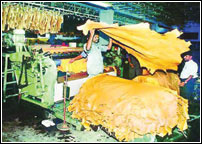 WHILE prices of sacrificial animals are being quoted 20 to 25 per cent higher than that of last Eid-ul-Azha, tanners are offering 20 to 25 per cent less prices on hides and skins of goats, cows and sheep this time to collectors. Reason for this market aberration is the decline in demand of leather products, mainly of garments in Europe.
Three days’ sacrifices of animals on Eid provide 600 tanneries almost 15 to 20 per cent of their annual demand of hides and skins. Analysts estimate a fall in animal sacrifices this Eid as compared to previous years because of higher prices, rising domestic inflation and unemployment. While the global recession is posing a big question mark on export prospects of all range of value added leather products in the second half of this fiscal year.
‘’Our buyers of leather garments in Europe are asking for a drastic price slash, booking a much reduced volume of business for next spring in March/April 2009’’, Mr Fawad Ejaz, Chairman of the Pakistan Leather Garments Manufacturers and Exporters Association informed Dawn. He was elected last week. Real business opportunity for leather garment exporters is winter for which supplier stores in Europe and US give their sample designs almost a year before. ‘’For winter 2009, we have got much less samples’,’ he said. that indicates that export prospects for 2009-10 were not bright.
Leather products export showed normal trend during July/October 2008. The overall export of leather and leather products dropped 0.44 per cent to $357.35 million as against $358.92 million last year. However, what is bothering industry is more than 14 per cent drop in the same period in export of leather to $112.68 million as against $131.60 million last year. Pakistani leather was being imported by other countries for value added products. A drop in demand of leather suggests fall in demand of leather products in world market.
The leather garment manufacturers are being asked to lower the prices of their products. Importers are placing order for lower volume of business. ‘’We are servicing winter orders given in July and August,’’ he said. But the deepening of recession in Europe and US after September onward has started hitting suppliers of textiles and leather products in Asia.
China, the biggest supplier of leather products to US and Europe is battling the situation by offering its exporters rebate of 17 per cent to help them stay in the market and enable them to secure a bit more space by squeezing other countries out. ‘’Our repeated pleas to give six per cent research and development subsidy on export remained un-responded till today’’, he said. ‘’Once pushed out for any reason, it is next to impossible to regain that position again in the market’’, he warned.
The Federal Commerce Secretary, Syed Asif Shah also sees hard days ahead for exporters as recession in the western markets is eroding purchasing powers of consumers. Officials in finance and commerce ministries in Islamabad and Karachi however rule out any financial assistance for the exporters as the government is facing acute cash crunch.
‘’As against more than Rs20 billion annual subsidy given to textile exporters in 2006-07, the demand of the leather exporters is only Rs1.6 billion a year’’, Fawad pleaded.
The leather industry leaders are planning to meet the government at various levels- from federal minister to secretary and officials of the Trade Development Authority of Pakistan (TDAP)- to brief them about their pressing problems.
Only three years ago, leather and leather products joined the billion dollars export club. These fetched $1.2 billion export in 2007-08 up almost 20 per cent over $1 billion in 2006-07. Encouraged by this trend, the planners were expecting $1.5 billion export of leather and leather products in 2008-09.
Even though the leather exports appear to be coming under dark clouds of global recession, the footwear segment offers some light at the end of the tunnel. It was the only product that was given six per cent R and D subsidy on export, though quite late. This subsidy has been suspended since June 25 last and the shoemakers are seeking its restoration.
Footwear export in first four months is up by more than 19 per cent. It is reported to have made some inroads in European markets but without any presence in the US where annual demand for shoes is more than $10 billion. China controls almost 50 per cent of the US market followed by Brazil which is said to be sharing hardly seven per cent.
‘’Supply orders from the US are very big and at much competitive rates,’’ Nasir Anwar Sheikh, the recently elected Chairman of Pakistan Shoe Manufacturers Association (PSMA) informed from Lahore. He said shoe industry is gradually coming of age but still does not have the capacity to service huge orders from the US.
While making inroads in the export market, the local shoe market is catering to domestic market as well. The two big shoe units-Bata and Service-control lion’s share of Rs50 to Rs60 billion market while the upcoming units are also emerging as tough competitors. This is more than evident from the designs and makes of the shoes that two big companies are now forced to offer because of competition in the market. A recent development in the local shoe industry is formation of almost two dozen independent marketing companies that have come in a big way with brand names.
‘’Yes, we can compete in Indian market too’’, Chairman of the PSMA replied. India is a huge market of $1.3 billion where quite a few giant multinationals have invested to manufacture specific parts of shoes such as soles, internal lining cloth and thread. ‘’For long we have been demanding supply of these basic ingredients from India through overland route via Wagah border’’, he said.
Anwar Nasir said Pakistani leather is considered to be of best quality. But it is hardly 60 per cent of a shoe. Much of 40 per cent ingredient of a shoe is imported which can be obtained from India at a much lower price. Moreover we will get advantage of a cut down on inventory cost also.