0
0

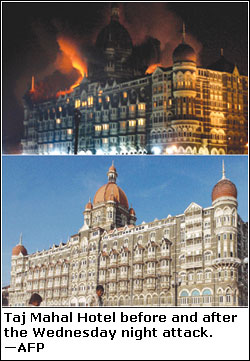 MUMBAI: In the harsh morning light there was no escaping the truth: the Taj Mahal Hotel, Mumbai’s iconic luxury hotel, was hurting after gunmen laid siege to it.
As angry orange flames resisted firemen’s attempts to douse them, thick black smoke billowed from the heritage, or palace, wing, obscuring the distinctive central dome and smaller cupolas that are an integral part of south Mumbai’s skyline.
Soot marred the red-white-and-grey-brick facade, and curious onlookers, anxious hotel employees, tired reporters all gaped at the hotel, tut-tutting and shaking their heads.
A spokesman for the hotel, owned by Tata Group’s Indian Hotels Co, said in a statement: “The Taj is very much a symbol of India. We will rebuild every inch that has been damaged in this attack and bring back the Taj to its full glory.”
That will be tough in this day and age.
The brainchild of wealthy industrialist Jamsetji Tata, the hotel was built at a cost of a quarter of a million pounds more than 100 years ago, and boasted such features as the first air-conditioned ballroom in the country and a Turkish bath.
One story of its origin is that Tata took a foreign friend to dinner in a plush Mumbai hotel, only to be told he was not welcome since he was Indian.
Slighted, Tata vowed to build a finer hotel that would welcome all Indians, and set about his mission with zeal.
He leased a plot of land of about two acres on reclaimed land on Mumbai’s seafront, and got involved in its design and interiors, shopping at London, Dusseldorf, Berlin and Paris.
A more apocryphal story of its design, an example of Indo-Sarcenic architecture, is that the entrance to the hotel is actually in the back, and not on the sea-front, with construction workers messing up the plan when the architect was away.
Either way, with its vaulted alabaster ceilings, onyx columns, graceful archways, crystal chandeliers and a dramatic cantilever staircase that employees refer to as the “grand staircase”, the hotel always makes a big impression on visitors.
Inaugurated in 1903, it welcomed the Prince of Wales on his state visit two years later in an ironic twist.
Tourists and locals have wandered its hallways, admiring its art and a collection of black-and-white photographs of some of the maharajas, presidents, rock stars and chief executives who have stayed, including John Lennon and John F. Kennedy.
The 1970s saw the addition of a more modern tower wing alongside, but its arched balconies failed to impress.
Everyone goes to Leo’s
Less dramatic but just as beloved to locals and tourists in Mumbai is Leopold’s Cafe, a popular bar on the bustling Colaba Causeway road, the nerve centre of shopping and dining.
Opening in 1871 as a wholesale oil store, it later became a restaurant, and then opened an on-site pub in the 1990s. Always popular for cheap beer and greasy snacks, it shot to fame when it was featured in the bestselling 2003 novel “Shantaram”.A stack of books autographed by Australian author Gregory David Roberts sits prominently on a counter in the cafe.
With its chequered tablecloths and doors that open wide on to the sidewalk, Leopold’s is also known as the place for tourists to land a role in a Bollywood movie.
But the grim scene of blood-spattered shoes and napkins outside the shuttered cafe on Wednesday after gunmen fired at guests was a far cry from lavish Bollywood musicals.
A senior British executive for a foreign firm who has been in India for over a year, said life had to go on after the attacks.
“It’s one of those things we have to live with and we have to get back to normal as soon as we can,” he said.
“But just to walk into Leopold’s – that’s so horrific.”—Reuters