0
0

ISLAMABAD, May 10: The government has invited chemists and druggists on May 16 for negotiations on the issue of general sales tax (GST) on medicines, an official source told Dawn on Friday.
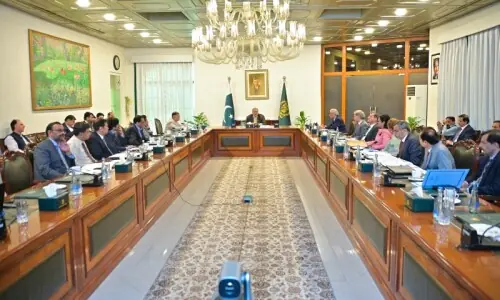
The meeting has been scheduled after approval of a list of 10-member chemist council, submitted recently to the government, the source said.
A three-member ministerial committee, comprising finance minister Shaukat Aziz, health minister Dr Abdul Malik Kasi and commerce minister Abdul Razak Dawood, was recently constituted to negotiate with the chemists’ association.
The chemist council, which will meet with the president, comprise Haji Mohammad Hanif Billo and Mohammad Afzal from Karachi; Nadeem Shami and Mian Abdul Rashid, Lahore; Abdul Hadi Khan and Mohammad Iqbal Khan, Peshawar; Mohammad Hanif Abbasi, Arshad Mahmood Awan, Mohammad Arif Sheikh and Raja Sadaqat, Islamabad.
The meeting was promised by the finance minister after All Pakistan Chemist and Druggist Association had called off strike on April 25.
Mohammad Hanif Abbasi, chairman of Chemist Association Punjab and president of Markazi Anjuman-i-Tajaran Rawalpindi, talking to Dawn, hoped that the government would sympathetically consider their demands for withdrawing the 15 per cent GST on medicines.
The chemists and druggist are not accepting government’s decision of exempting 256 medicines from the GST on the grounds that the list of the exempted drugs was incomplete and confusing, he said.
Meanwhile, a source told Dawn that a summary on the deregulation of medicine prices had been submitted by the commerce and industries ministry to the Cabinet for approval.
The committee, which finalized the summary, was headed by commerce minister Razzaq Dawood, while health and finance ministers were its members.
The multi-national pharmaceutical manufacturers were pushing the government to deregulate the drug sector, saying they were spending a lot of money on research and development in Pakistan, but were forced to sell medicine on cheaper rates, the source said.
The government planners believe that the prices of the medicines will go down through deregulation since the market forces then determine the prices. However, the source said the prices would increase if the medicine sector was deregularized.
He cited the example of few commonly-used medicines, the prices of which were raised 200 to 1000 per cent after the last deregulation.
Meanwhile, Foundation for the Preferment of Pharmaceutical Sciences (FPPS), in a statement, has stressed the need for a strong regulatory body to check drug prices. It said the market forces could not determine or regulate the price of a medicine.
The statement said pharmaceutical industry was the most regulated and sensitive sector in the world. It quoted the example of Food and Drug Association (FDA) of United States which maintained strict rules because there was no choice for patients in medicines.