KARACHI, Oct 25: Poor are now well over 44 per cent of Pakistan’s population who include 28 per cent living in abject poverty, Shaukat Tareen, the prime minister’s adviser on finance, informed a packed hall of moaning and groaning businessmen here on Saturday at the Federation of Pakistan Chambers of Commerce and Industry (FPCCI).
More than two dozen businessmen spoke on the occasion in almost two and half hours meeting and complained virtually against everything in the country — banks’ spread, electricity bills, power outages, law and order, taxation policies, etc., — and quite many of them including a senior leader Tariq Sayeed made a forceful plea “to avoid International Monetary Fund (IMF).”
“I will not be happy to join IMF programme and will do all possible to avoid it,” the adviser replied with a plea “after all the country’s interest is supreme and the decision will be taken in best national interest.”
He did indicate that if Pakistan decides to join IMF “it will be on our terms.”
“We will certainly not default,” he declared in a firm tone, but he did not provide any information as to how much foreign payments were due before December and thereafter in second half of 2008-09 and what were the available resources.
“We have plans and we are determined to stop and bring our borrowing from State Bank of Pakistan to zero,” he said and added that the country would maintain a flexible exchange rate.
Responding to an observation made by FPCCI President Tanveer Sheikh in his address of welcome who apprehended about banks’ liquidity released recently might be diverted to “maintain stock exchange indicators,” Mr Tareen said “you will get money but no one has a monopoly.”
“I have no information whether crop loan insurance scheme is not moving ahead,” he replied to a question of a journalist who informed him that the prime minister had pledged to launch crop insurance on loans for Rabi crop. “I will make enquiries in Islamabad,” the adviser said.
He indicates that electricity crisis will be diluted in coming weeks after all IPPs are asked to start operating on optimum capacity, augmentation of hydel power and other sources. However, he was not ready to buy businessmen complaint on banking spread issue and offered a lengthy reply to justify the existing position.
Nonetheless, he did concede some of the big banks might be trying to take advantage of the situation and demanding a high interest from the borrowers. All through his speech, the adviser spoke in generalised terms.
In response to a plea made by the FPCCI president to “revive confidence in business community by unleashing your strategy,” what Mr Tareen spelt out was augmentation of resources by raising tax-to-GDP ratio to 15 per cent from existing 10 per cent and curtailing of government expenditures.
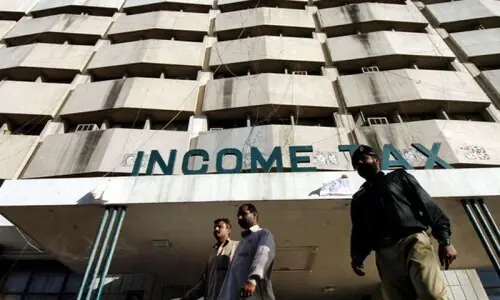
“VAT and tax on income are the only future taxes and all other taxes —presumptive and withholding — will be eliminated,” he replied to a number of questions on taxation system without elaborating as to how it would be done and when.
Mr Tareen endorsed the FPCCI president’s plea to associate businessmen bodies in planning activities.
“Our monetary, industrial and investment policies should be coordinated,” proposed Mr Tanveer Sheikh in his welcome of address.
The prime minister’s adviser expressed the view that Planning Commission was at present focusing only projects and ignoring planning which was its basic function.
Mr Tareen proposed setting in place of a think tank of business representatives, experts and government people to constantly draw up coordinated policies and then constantly reviewing and changing as and when it becomes necessary.
He said that the thrust of economic policies would now be shifted to production-led growth from consumption-driven strategy and that agriculture would be given top priority.
The FPCCI president offered a comparison of electricity tariffs of Bangladesh, India, China and Sri Lanka to prove that consumers in Pakistan were paying the highest tariff.
Industry, he said, consumes almost 40 per cent of electricity and hence bears the cost which is reflected in production cost rendering it uncompetitive.