0
0

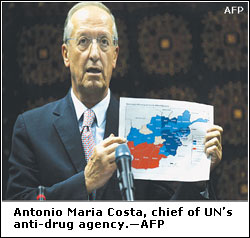 KABUL, Aug 26: Opium production dropped in Afghanistan this year for the first time since 2001, the United Nations said on Tuesday, but that may have more to do with the weather than international efforts to cut the drug crop.
Afghanistan broke all records and produced 93 per cent of the world’s opium in 2007. This year, 157,000 hectares grew opium poppy, compared with 193,000 hectares in 2007, a 19 per cent decrease, the UN Office on Drugs and Crime (UNODC) said.
But production fell by only 6 per cent, from 8,200 tonnes last year to 7,700 tonnes in 2008 as crop yields went up and more of the production was concentrated in the more fertile south, some two-thirds of it in Helmand province.
“The country might have turned the corner. The situation has finally started to improve,” said Antonio Maria Costa, the head of UNODC.
“But whether this is a long-term, permanent reduction, the answer is hard to say ... the situation is vulnerable to a relapse.”
The number of poppy-free provinces grew to 18 from 13 last year. Most of the gains were in northern Afghanistan, with 98 per cent of poppy cultivation now restricted to seven provinces in the south and west where Taliban insurgents and criminals are most active, the UNODC said in its annual report.
“This geographical overlap between regions of opium and zones of insurgency shows the inextricable link between drugs and conflict,” it said. “Since drugs and insurgency are caused by, and effect, each other, they need to be dealt with at the same time — and urgently.”
Afghanistan has seen a surge in violence this year with the Taliban launching more daring and deadly attacks on Afghan and foreign forces and killing more troops than ever before.
BAD WEATHER: Since 2001, international donors have pumped hundreds of millions of dollars into stopping cultivation, processing and trafficking of opium which is processed into highly addictive heroin. But this year’s drop in cultivation was largely due to a drought and a fall in the price of opium.
“The reduction this year that we’re seeing overall, we think, is probably largely due to the weather, the climate and economics,” said a senior anti-narcotics official at the British Embassy in Kabul.
Large parts of the country, particularly the north and northwest where cultivation is mostly rain-fed, suffered droughts this year resulting in widespread crop failures.
Steady falls in the price of opium also provides less incentive for farmers to grow poppy, said Belgrove. The price of fresh opium in Afghanistan dropped to $70 per kg this year, down from $283 in 2003, the UNODC says.
Combined with the rise in global food prices, this has narrowed the income ratio of opium to wheat from 10:1 in 2007 to 3:1 in 2008 which may provide further incentive for farmers to switch to legal crops, the UN said.
“The economic foundations of the opium economy have finally been undermined,” said Costa. “That is a solid foundation for progress.”
Some success in reducing poppy production this year can be attributed to strong local government, particularly in the case of Nangarhar province, experts say. In 2007 Nangarhar, was the second highest producer of opium, this year it is poppy free.
“Judging from the fact that there are now 18 opium-free provinces, a growing number of governors are really playing by the rule book,” said Costa.—Reuters