0
0

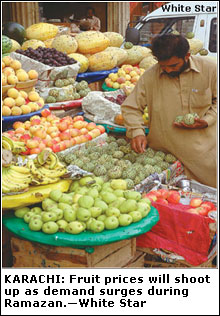 KARACHI, Aug 24: With Ramazan only a week away, the prices of fruit are climbing steadily and the wholesalers claim that the rates have almost doubled when compared to last year.
Heavy rains in the northern parts of the country and Punjab, devastated roads, rising transport cost and a poor law and order situation in the north may be blamed for the rising rates and thin supply of fruit in Karachi.
Expecting a substantial demand in the holy month, fruit retailers have already pushed up the rates by charging double the prices in some cases than the actual wholesale rates in Subzi Mandi.
The city government continues to check prices but consumers are yet to see results. Like previous years, they will intervene by calling a meeting with fruit wholesalers in the end and ultimately the traders will succeed in fixing the higher rates.
Irrespective of fixing of fruit rates, retailers have always violated the official price list by charging double price from the first day of the holy month as they know that consumers will buy fruit at any cost.
Poor strength
Because of very low staff strength of 36 officials (having magisterial powers) for the mega-city divided into 18 towns, the price checking exercise usually fizzles out every year as these officials are supposed to check prices of other essential items also.
Like past practice, the city government has never bothered to ascertain the demand and supply gap, stock situation, crop condition and other aspects that become the main causes of surging rates before Ramazan. Due to no random statistics in hand during the meeting, they easily get under pressure from the wholesalers and finally higher prices are fixed.
Retailers are charging Rs60-80 per kg for the high quality Gaja apple, which some retailers sell as Kullu and Golden apple to the uninformed consumers. Earlier this month, it was sold at Rs40 per kg. In the wholesale market, it sells at Rs60 per kg.
The rate of grapes ranges from Rs100 to Rs120 per kg while their wholesale rate is Rs60-70 per kg. In the first week of this month grapes was selling at Rs80 per kg. The rate of watermelon is Rs40 per kg while it is available at Rs20-25 per kg in the wholesale market. Earlier this month it was selling at Rs25-30 per kg. The rate of Chikoo is tagged at Rs60 per kg while its wholesale rate hovers between Rs25 and Rs30 per kg.
Peaches now sell at Rs100-120 per kg as compared to Rs60-70 per kg in the fist week of this month. At the wholesale stage, they sell at Rs60-70 per kg.
Chaunsa mango is at the end of its season but it sells at Rs60 per kg as compared to Rs40-45 per kg three weeks back, while another high quality mango is available at Rs80 per kg as compared to its earlier rate of Rs60 per kg.
Banana still sells between Rs40 and Rs50 per dozen while it was available at Rs30 per dozen earlier this month. Its wholesale rate ranges from Rs15 to Rs20 per dozen. Sweet lemon sells at Rs60 per kg while its wholesale price is Rs50 per kg. The general-secretary of the Karachi Fresh Fruits Association, Akhtar Baloch, said that when the wholesale rates were double than last year’s, then one could expect a substantial rise in Ramazan.
Giving an example, he said the price of old stock of Basra date was currently hovering between Rs1,800 and Rs2,000 per 40kg while last year its fresh product was sold between Rs600 and Rs800. He said the quality of Basra date had been damaged by rains in the producing areas such as Khairpur, Sukkur, Makran and Turbat.
He said the price of Gaja apple this year was Rs600-800 per 10-12 kg wooden box as compared to Rs300-400 last year. This year rains in Balochistan had created supply problems in Karachi. Besides, its size is also small. Kullu and Golden apples will arrive here during Ramazan.
He said the arrival of peaches had been negligible after rains in Swat coupled with the poor law and order situation and curfew.
About banana, he said the fruit had arrived late in the markets from Sindh and Balochistan. Disagreeing with the city government’s effort to fix fruit prices, he clearly warned that this year there would be no relief for consumers owing to the rising wholesale prices.
“The wholesale rates are not fixed in any part of the world. There is an open auction and the rate usually fluctuates on demand and supply. When the supply improves the rates come down at throwaway prices,” he said.
Vegetables
The rate of onion (arriving from Balochistan), the most sought-after item of Ramazan, has still not come down from Rs25 per kg, while it was available at Rs18 per kg earlier this month. Its wholesale price still ranges between Rs20 and Rs22 per kg.
The potato rate has also not come down from the current Rs20 per kg. A wholesaler said that some 2,000-3,000 tons of potato was arriving daily from Afghanistan, Iran and India but it was still insufficient to meet the demand. Its wholesale rate was Rs15-Rs16 per kg. Tomato, which is available at Rs30 per kg at wholesale, sells at Rs40-Rs50 per kg at the retail side.
Meanwhile, the official in charge of the CDGK’s price checking campaign, Matanat Ali Khan, said the campaign had been going on for the last six months in which retailers and wholesalers were sent to jail and fined.
When asked why the results of the campaign had not caused any fall in prices, he simply said that the officials were trying their best to check prices of everything.