



 0
0

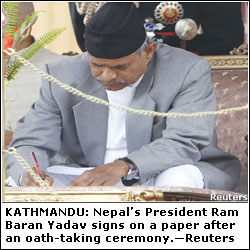 KATHMANDU: The first president of newly republican Nepal was sworn into office on Wednesday, but the country remained in political limbo, with the former Maoist rebels refusing to form a government under him.
Ram Baran Yadav took his oath in Nepal's new constitutional assembly, which had voted on May 28 to sack unpopular king Gyanendra and abolish the Himalayan country's 240-year-old monarchy.
“I, in the name of God take the oath of office that I will remain committed to the nation and its people to fulfil the duty with my utmost honesty and protect the sovereignty and freedom of the nation,” the new president said.
The president, who was supported by the centrist Nepali Congress party, was voted in on Monday, infuriating the Maoists — who hold the largest bloc of seats in the assembly but not an outright majority.
The presidency is a largely ceremonial position but the Maoists — who ended a decade of civil war to enter mainstream politics — are refusing to form a government.
They had insisted their choice of president should be elected, arguing Yadav's victory would give them little room to manoeuvre should they form a government, and little chance of implementing key platform pledges like radical land reform.
Maoist party chief Prachanda did not attend Wednesday's swearing-in ceremony, instead sending his deputy Baburam Bhattarai and another senior party member, Dinanadh Sharma.
Sharma said his party remained committed to the rewriting of Nepal's constitution.
“We are really very happy. Because of our struggle — without any compromise — the agenda that we laid has been institutionalised officially on this day,” he said.
“Of course all the problems will not be over. We have to industrialise the country and we have to bring about an economic and cultural revolution. Our main priority will be to draft the new constitution and we will be involved in that even if we are not part of the government.” France's ambassador to Nepal, Gilles-Henry Garault said that the swearing-in of Yadav was a historically significant day for the impoverished Himalayan nation and would set it on the right path for the future.
“Nepal has just passed through the most difficult period of history by abolishing the monarchy. It's a very important day for Nepal and the international community as Nepal has got a first president,” he said.
“It's the first step towards building a peaceful and prosperous Nepal.” Yadav, who arrived at the assembly building in a Jaguar once used by the former king for official duties, also administered the same oath to vice president Parmananda Jha.
Yadav, a 61-year-old former health minister and trained medical doctor, has said he plans to use his new position to try to unite Nepal and address grievances among the country's ethnic communities.
In a statement congratulating Yadav earlier this week, UN chief Ban Ki-moon has urged all parties to “cooperate in forming a new government which will carry forward Nepal's peace process.”—AFP





























